

Library of America
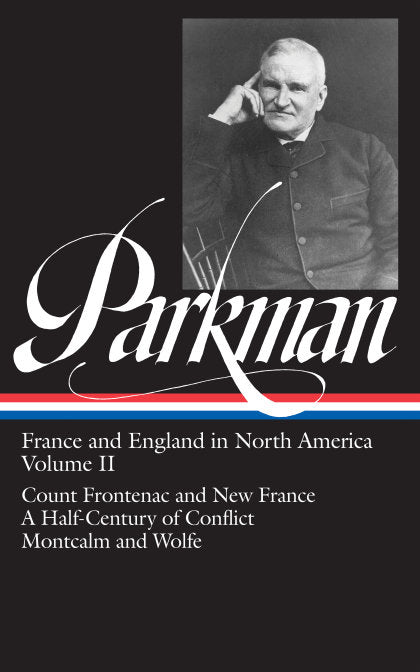
Francis Parkman: France and England in North America Vol. 2 (LOA #12)
Francis Parkman: France and England in North America Vol. 2 (LOA #12)
Couldn't load pickup availability
Collapsible content
ABOUT
Count Frontenac and New France under Louis XIV (1877) details how France might have won her imperial struggle with England. Frontenac, a courtier who was made governor of New France by that most sagacious of monarchs, oversaw the colony’s brightest era of growth and influence. Had Canada’s later governors possessed his administrative skill and personal force, his sense of diplomacy and political talent, or his grasp of the uses of power in a modern world, the English colonies to the south might have become part of what Frontenac saw as a continental scheme of French dominion.
England’s American colonies flourished, while France, in both the Old World and the New, declined from its greatness of the late seventeenth century. Conflict over the developing western regions of North America erupted in a series of colonial wars. As narrated by Parkman in A Half-Century of Conflict (1892), these American campaigns, while only part of a larger, global struggle, prepared the colonies for the American Revolution.
In Montcalm and Wolfe (1884) Parkman describes the fatal confrontation of the two great French and English commanders whose climactic battle marked the end of French power in America. As the English colonies cooperated for their own defense, they began to realize their common interests, their relative strength, and their unique position. In this imperial war of European powers we also begin to see the American figures—Benjamin Franklin, George Washington—soon to occupy a historical stage of their own.
LIBRARY OF AMERICA is an independent nonprofit cultural organization founded in 1979 to preserve our nation’s literary heritage by publishing, and keeping permanently in print, America’s best and most significant writing. The Library of America series includes more than 300 volumes to date, authoritative editions that average 1,000 pages in length, feature cloth covers, sewn bindings, and ribbon markers, and are printed on premium acid-free paper that will last for centuries.
STANDARD, PRIMARY, DM AND VARIANT COVERS
Standard and Primary covers are widely available through general retailers. They often have higher print runs and can be cheaper, especially during sales.
In contrast, Direct Market (DM) and variant covers are primarily sold in comic shops. DM editions tend to have more limited availability and may be more valuable to collectors.
The main differences lie in artwork style, availability, price, and collector appeal. Ultimately, the choice between standard and variant covers depends on personal preference, budget, and individual collecting goals.
PRODUCT TYPES
Comic book enthusiasts have various formats to choose from when collecting their favorite stories.
Here's a brief overview of the main types:
Omnibus
- Large, hardcover collections
- Usually contain complete runs or extensive story arcs
- Typically 800-1000+ pages
- Higher price point, often €100-€150
Oversized Hardcover (OHC)
- Similar dimensions to omnibus, but thinner
- Collect shorter runs or story arcs
- Usually 300-600 pages
- Priced between €30-€50
Hardcover (HC)
- Standard-sized hardcover books
- Collect 6-12 issues typically
- Similar dimensions to single issues, but with a hard cover
- Priced around €25-€35
Trade Paperback (TP)
- Softcover collections
- Standard comic book size
- Usually collect 4-6 issues
- Most affordable option, typically €15-€25
Other Formats
- Absolute Editions: Oversized, deluxe hardcovers (mainly DC Comics)
- Compendiums: Massive paperback collections
- Graphic Novels (OGN/GN): Original stories not previously released as single issues
The choice between these formats often depends on personal preference, budget, and collecting goals. Omnibus and OHC editions offer larger artwork and more content but at a higher price, while TPs provide a more affordable way to collect complete story arcs