

Library of America
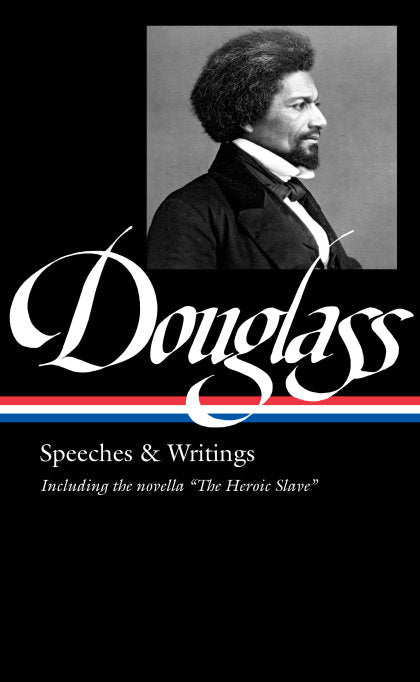
Frederick Douglass: Speeches & Writings (LOA #358)
Frederick Douglass: Speeches & Writings (LOA #358)
Couldn't load pickup availability
Collapsible content
ABOUT
Edited by Pulitzer Prize–winning biographer David W. Blight, this Library of America edition is the largest single-volume selection of Frederick Douglass’s writings ever published, presenting the full texts of thirty-four speeches and sixty-seven pieces of journalism. (A companion Library of America volume, Frederick Douglass: Autobiographies, gathers his three memoirs.) With startling immediacy, these writings chart the evolution of Douglass’s thinking about slavery and the U.S. Constitution; his eventual break with William Lloyd Garrison and many other abolitionists on the crucial issue of disunion; the course of his complicated relationship with Abraham Lincoln; and his deep engagement with the cause of women’s suffrage.
Here are such powerful works as “What to the Slave Is the Fourth of July?,” Douglass’s incandescent jeremiad skewering the hypocrisy of the slaveholding republic; “The Claims of the Negro Ethnologically Considered,” a full-throated refutation of nineteenthcentury racial pseudoscience; “Is it Right and Wise to Kill a Kidnapper?,” an urgent call for forceful opposition to the Fugitive Slave Act; “How to End the War,” in which Douglass advocates, just days after the fall of Fort Sumter, for the raising of Black troops and the military destruction of slavery; “There Was a Right Side in the Late War,” Douglass’s no-holds-barred attack on the “Lost Cause” mythology of the Confederacy; and “Lessons of the Hour,” an impassioned denunciation of lynching and disenfranchisement in the emerging Jim Crow South.
As a special feature the volume also presents Douglass’s only foray into fiction, the 1853 novella “The Heroic Slave,” about Madison Washington, leader of the real-life insurrection on board the domestic slave-trading ship Creole in 1841 that resulted in the liberation of more than a hundred enslaved people. Editorial features include detailed notes identifying Douglass’s many scriptural and cultural references, a newly revised chronology of his life and career, and an index.
STANDARD, PRIMARY, DM AND VARIANT COVERS
Standard and Primary covers are widely available through general retailers. They often have higher print runs and can be cheaper, especially during sales.
In contrast, Direct Market (DM) and variant covers are primarily sold in comic shops. DM editions tend to have more limited availability and may be more valuable to collectors.
The main differences lie in artwork style, availability, price, and collector appeal. Ultimately, the choice between standard and variant covers depends on personal preference, budget, and individual collecting goals.
PRODUCT TYPES
Comic book enthusiasts have various formats to choose from when collecting their favorite stories.
Here's a brief overview of the main types:
Omnibus
- Large, hardcover collections
- Usually contain complete runs or extensive story arcs
- Typically 800-1000+ pages
- Higher price point, often €100-€150
Oversized Hardcover (OHC)
- Similar dimensions to omnibus, but thinner
- Collect shorter runs or story arcs
- Usually 300-600 pages
- Priced between €30-€50
Hardcover (HC)
- Standard-sized hardcover books
- Collect 6-12 issues typically
- Similar dimensions to single issues, but with a hard cover
- Priced around €25-€35
Trade Paperback (TP)
- Softcover collections
- Standard comic book size
- Usually collect 4-6 issues
- Most affordable option, typically €15-€25
Other Formats
- Absolute Editions: Oversized, deluxe hardcovers (mainly DC Comics)
- Compendiums: Massive paperback collections
- Graphic Novels (OGN/GN): Original stories not previously released as single issues
The choice between these formats often depends on personal preference, budget, and collecting goals. Omnibus and OHC editions offer larger artwork and more content but at a higher price, while TPs provide a more affordable way to collect complete story arcs