

Random House Publishing Group
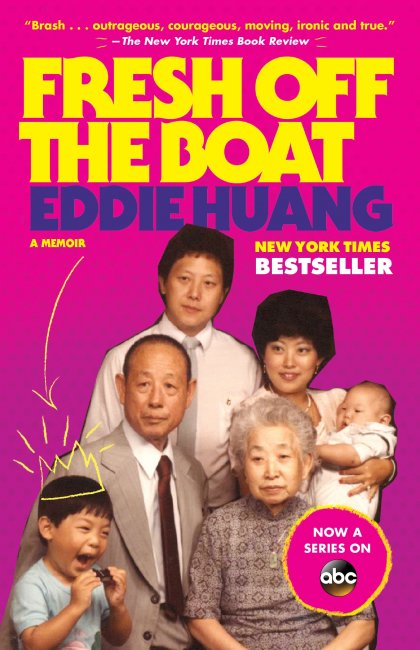
Fresh Off the Boat
Fresh Off the Boat
Couldn't load pickup availability
Collapsible content
ABOUT
“Bawdy and frequently hilarious . . . a surprisingly sophisticated memoir about race and assimilation in America . . . as much James Baldwin and Jay-Z as Amy Tan . . . rowdy [and] vital . . . It’s a book about fitting in by not fitting in at all.”—Dwight Garner, The New York Times
NATIONAL BESTSELLER • NAMED ONE OF THE BEST BOOKS OF THE YEAR BY KIRKUS REVIEWS
Assimilating ain’t easy. Eddie Huang was raised by a wild family of FOB (“fresh off the boat”) immigrants—his father a cocksure restaurateur with a dark past back in Taiwan, his mother a fierce protector and constant threat. Young Eddie tried his hand at everything mainstream America threw his way, from white Jesus to macaroni and cheese, but finally found his home as leader of a rainbow coalition of lost boys up to no good: skate punks, dealers, hip-hop junkies, and sneaker freaks. This is the story of a Chinese-American kid in a could-be-anywhere cul-de-sac blazing his way through America’s deviant subcultures, trying to find himself, ten thousand miles from his legacy and anchored only by his conflicted love for his family and his passion for food. Funny, moving, and stylistically inventive, Fresh Off the Boat is more than a radical reimagining of the immigrant memoir—it’s the exhilarating story of every American outsider who finds his destiny in the margins.
Praise for Fresh Off the Boat
“Brash and funny . . . outrageous, courageous, moving, ironic and true.”—New York Times Book Review
“Mercilessly funny and provocative, Fresh Off the Boat is also a serious piece of work. Eddie Huang is hunting nothing less than Big Game here. He does everything with style.”—Anthony Bourdain
“Uproariously funny . . . emotionally honest.”—Chicago Tribune
“Huang is a fearless raconteur. [His] writing is at once hilarious and provocative; his incisive wit pulls through like a perfect plate of dan dan noodles.”—Interview
“Although writing a memoir is an audacious act for a thirty-year-old, it is not nearly as audacious as some of the things Huang did and survived even earlier. . . . Whatever he ends up doing, you can be sure it won’t look or sound like anything that’s come before. A single, kinetic passage from Fresh Off the Boat . . . is all you need to get that straight.”—Bookforum
STANDARD, PRIMARY, DM AND VARIANT COVERS
Standard and Primary covers are widely available through general retailers. They often have higher print runs and can be cheaper, especially during sales.
In contrast, Direct Market (DM) and variant covers are primarily sold in comic shops. DM editions tend to have more limited availability and may be more valuable to collectors.
The main differences lie in artwork style, availability, price, and collector appeal. Ultimately, the choice between standard and variant covers depends on personal preference, budget, and individual collecting goals.
PRODUCT TYPES
Comic book enthusiasts have various formats to choose from when collecting their favorite stories.
Here's a brief overview of the main types:
Omnibus
- Large, hardcover collections
- Usually contain complete runs or extensive story arcs
- Typically 800-1000+ pages
- Higher price point, often €100-€150
Oversized Hardcover (OHC)
- Similar dimensions to omnibus, but thinner
- Collect shorter runs or story arcs
- Usually 300-600 pages
- Priced between €30-€50
Hardcover (HC)
- Standard-sized hardcover books
- Collect 6-12 issues typically
- Similar dimensions to single issues, but with a hard cover
- Priced around €25-€35
Trade Paperback (TP)
- Softcover collections
- Standard comic book size
- Usually collect 4-6 issues
- Most affordable option, typically €15-€25
Other Formats
- Absolute Editions: Oversized, deluxe hardcovers (mainly DC Comics)
- Compendiums: Massive paperback collections
- Graphic Novels (OGN/GN): Original stories not previously released as single issues
The choice between these formats often depends on personal preference, budget, and collecting goals. Omnibus and OHC editions offer larger artwork and more content but at a higher price, while TPs provide a more affordable way to collect complete story arcs