

Random House Publishing Group
Georgia
Georgia
Couldn't load pickup availability
Collapsible content
ABOUT
This is not a love story. If it were, we would have the same story. But he has his, and I have mine.
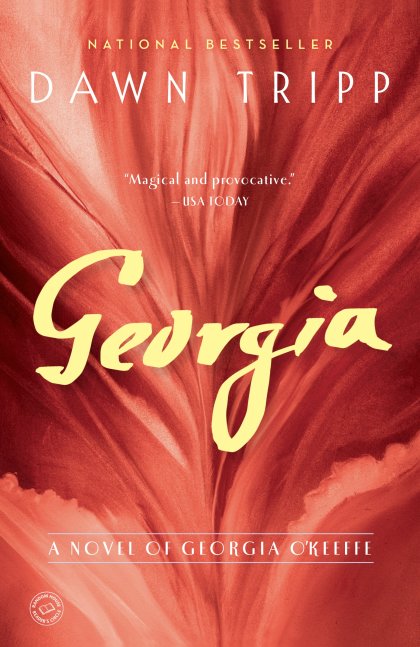
In 1916, Georgia O’Keeffe is a young, unknown art teacher when she travels to New York to meet Stieglitz, the famed photographer and art dealer, who has discovered O’Keeffe’s work and exhibits it in his gallery. Their connection is instantaneous. O’Keeffe is quickly drawn into Stieglitz’s sophisticated world, becoming his mistress, protégé, and muse, as their attraction deepens into an intense and tempestuous relationship and his photographs of her, both clothed and nude, create a sensation.
Yet as her own creative force develops, Georgia begins to push back against what critics and others are saying about her and her art. And soon she must make difficult choices to live a life she believes in.
A breathtaking work of the imagination, Georgia is the story of a passionate young woman, her search for love and artistic freedom, the sacrifices she will face, and the bold vision that will make her a legend.
Praise for Georgia
“Complex and original . . . Georgia conveys O’Keeffe’s joys and disappointments, rendering both the woman and the artist with keenness and consideration.”—The New York Times Book Review
“As magical and provocative as O’Keeffe’s lush paintings of flowers that upended the art world in the 1920s . . . Tripp inhabits Georgia’s psyche so deeply that the reader can practically feel the paintbrush in hand as she creates her abstract paintings and New Mexico landscapes. . . . Evocative from the first page to the last, Tripp’s Georgia is a romantic yet realistic exploration of the sacrifices one of the foremost artists of the twentieth century made for love.”—USA Today
“Sexually charged . . . insightful . . . Dawn Tripp humanizes an artist who is seen in biographies as more icon than woman. Her sensuous novel is as finely rendered as an O’Keeffe painting.”—The Denver Post
“A vivid work forged from the actual events of O’Keeffe’s life . . . [Tripp] imbues the novel with a protagonist who forces the reader to consider the breadth of O’Keeffe’s talent, business savvy, courage and wanderlust. . . . [She] is vividly alive as she grapples with success, fame, integrity, love and family.”—Salon
STANDARD, PRIMARY, DM AND VARIANT COVERS
Standard and Primary covers are widely available through general retailers. They often have higher print runs and can be cheaper, especially during sales.
In contrast, Direct Market (DM) and variant covers are primarily sold in comic shops. DM editions tend to have more limited availability and may be more valuable to collectors.
The main differences lie in artwork style, availability, price, and collector appeal. Ultimately, the choice between standard and variant covers depends on personal preference, budget, and individual collecting goals.
PRODUCT TYPES
Comic book enthusiasts have various formats to choose from when collecting their favorite stories.
Here's a brief overview of the main types:
Omnibus
- Large, hardcover collections
- Usually contain complete runs or extensive story arcs
- Typically 800-1000+ pages
- Higher price point, often €100-€150
Oversized Hardcover (OHC)
- Similar dimensions to omnibus, but thinner
- Collect shorter runs or story arcs
- Usually 300-600 pages
- Priced between €30-€50
Hardcover (HC)
- Standard-sized hardcover books
- Collect 6-12 issues typically
- Similar dimensions to single issues, but with a hard cover
- Priced around €25-€35
Trade Paperback (TP)
- Softcover collections
- Standard comic book size
- Usually collect 4-6 issues
- Most affordable option, typically €15-€25
Other Formats
- Absolute Editions: Oversized, deluxe hardcovers (mainly DC Comics)
- Compendiums: Massive paperback collections
- Graphic Novels (OGN/GN): Original stories not previously released as single issues
The choice between these formats often depends on personal preference, budget, and collecting goals. Omnibus and OHC editions offer larger artwork and more content but at a higher price, while TPs provide a more affordable way to collect complete story arcs