

Harmony/Rodale/Convergent
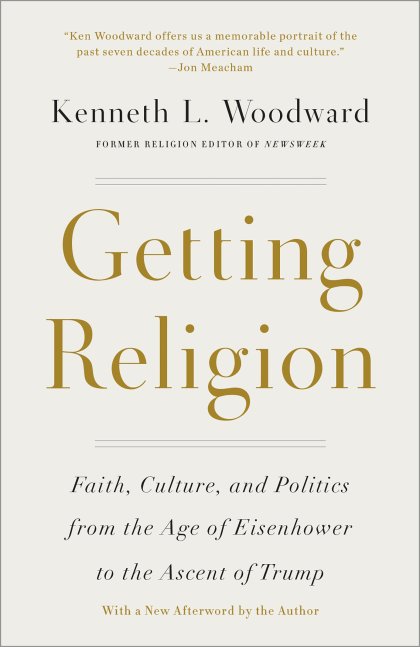
Getting Religion
Getting Religion
Couldn't load pickup availability
Collapsible content
ABOUT
Impeccably researched, thought-challenging and leavened by wit, Getting Religion, the highly-anticipated new book from Kenneth L. Woodward, is ideal perfect for readers looking to understand how religion came to be a contentious element in 21st century public life.
Here the award-winning author blends memoir (especially of the postwar era) with copious reporting and shrewd historical analysis to tell the story of how American religion, culture and politics influenced each other in the second half of the 20th century. There are few people writing today who could tell this important story with such authority and insight. A scholar as well as one of the nation’s most respected journalists, Woodward served as Newsweek’s religion editor for nearly forty years, reporting from five continents and contributing over 700 articles, including nearly 100 cover stories, on a wide range of social issues, ideas and movements.
Beginning with a bold reassessment of the Fifties, Woodward’s narrative weaves through Civil Rights era and the movements that followed in its wake: the anti-Vietnam movement; Liberation theology in Latin America; the rise of Evangelicalism and decline of mainline Protestantism; women’s liberation and Bible; the turn to Asian spirituality; the transformation of the family and emergence of religious cults; and the embrace of righteous politics by both the Republican and Democratic Parties.
Along the way, Woodward provides riveting portraits of many of the era’s major figures: preachers like Billy Graham and Jerry Falwell; politicians Mario Cuomo and Hillary Clinton; movement leaders Daniel Berrigan, Abraham Joshua Heschel, and Richard John Neuhaus; influential thinkers ranging from Erik Erikson to Elizabeth Kubler-Ross; feminist theologians Rosemary Reuther and Elizabeth Schussler-Fiorenza; and est impresario Werner Erhardt; plus the author’s long time friend, the Dalai Lama.
For readers interested in how religion, economics, family life and politics influence each other, Woodward introduces fresh a fresh vocabulary of terms such as “embedded religion,” “movement religion” and “entrepreneurial religion” to illuminate the interweaving of the secular and sacred in American public life.
This is one of those rare books that changes the way Americans think about belief, behavior and belonging.
STANDARD, PRIMARY, DM AND VARIANT COVERS
Standard and Primary covers are widely available through general retailers. They often have higher print runs and can be cheaper, especially during sales.
In contrast, Direct Market (DM) and variant covers are primarily sold in comic shops. DM editions tend to have more limited availability and may be more valuable to collectors.
The main differences lie in artwork style, availability, price, and collector appeal. Ultimately, the choice between standard and variant covers depends on personal preference, budget, and individual collecting goals.
PRODUCT TYPES
Comic book enthusiasts have various formats to choose from when collecting their favorite stories.
Here's a brief overview of the main types:
Omnibus
- Large, hardcover collections
- Usually contain complete runs or extensive story arcs
- Typically 800-1000+ pages
- Higher price point, often €100-€150
Oversized Hardcover (OHC)
- Similar dimensions to omnibus, but thinner
- Collect shorter runs or story arcs
- Usually 300-600 pages
- Priced between €30-€50
Hardcover (HC)
- Standard-sized hardcover books
- Collect 6-12 issues typically
- Similar dimensions to single issues, but with a hard cover
- Priced around €25-€35
Trade Paperback (TP)
- Softcover collections
- Standard comic book size
- Usually collect 4-6 issues
- Most affordable option, typically €15-€25
Other Formats
- Absolute Editions: Oversized, deluxe hardcovers (mainly DC Comics)
- Compendiums: Massive paperback collections
- Graphic Novels (OGN/GN): Original stories not previously released as single issues
The choice between these formats often depends on personal preference, budget, and collecting goals. Omnibus and OHC editions offer larger artwork and more content but at a higher price, while TPs provide a more affordable way to collect complete story arcs