

Penguin Publishing Group
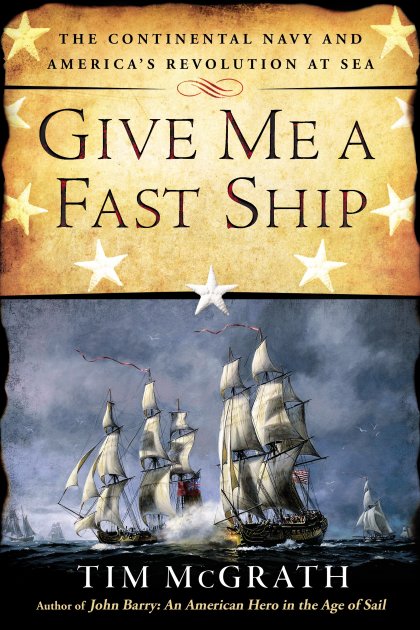
Give Me a Fast Ship
Give Me a Fast Ship
Couldn't load pickup availability
Collapsible content
ABOUT
America in 1775 was on the verge of revolution—or, more likely, disastrous defeat. After the bloodshed at Lexington and Concord, England’s King George sent hundreds of ships westward to bottle up American harbors and prey on American shipping. Colonists had no force to defend their coastline and waterways until John Adams of Massachusetts proposed a bold solution: The Continental Congress should raise a navy.
The idea was mad. The Royal Navy was the mightiest floating arsenal in history, with a seemingly endless supply of vessels. More than a hundred of these were massive “ships of the line,” bristling with up to a hundred high-powered cannon that could level a city. The British were confident that His Majesty’s warships would quickly bring the rebellious colonials to their knees.
They were wrong. Beginning with five converted merchantmen, America’s sailors became formidable warriors, matching their wits, skills, and courage against the best of the British fleet. Victories off American shores gave the patriots hope—victories led by captains such as John Barry, the fiery Irish-born giant; fearless Nicholas Biddle, who stared down an armed mutineer; and James Nicholson, the underachiever who finally redeemed himself with an inspiring display of coolness and bravery. Meanwhile, along the British coastline, daring raids by handsome, cocksure John Paul Jones and the “Dunkirk Pirate,” Gustavus Conyngham—who was captured and sentenced to hang but tunneled under his cell and escaped to fight again—sent fear throughout England. The adventures of these men and others on both sides of the struggle rival anything from Horatio Hornblower or Lucky Jack Aubrey. In the end, these rebel sailors, from the quarterdeck to the forecastle, contributed greatly to American independence.
Meticulously researched and masterfully told, Give Me a Fast Ship is a rousing, epic tale of war on the high seas—and the definitive history of the American Navy during the Revolutionary War.
STANDARD, PRIMARY, DM AND VARIANT COVERS
Standard and Primary covers are widely available through general retailers. They often have higher print runs and can be cheaper, especially during sales.
In contrast, Direct Market (DM) and variant covers are primarily sold in comic shops. DM editions tend to have more limited availability and may be more valuable to collectors.
The main differences lie in artwork style, availability, price, and collector appeal. Ultimately, the choice between standard and variant covers depends on personal preference, budget, and individual collecting goals.
PRODUCT TYPES
Comic book enthusiasts have various formats to choose from when collecting their favorite stories.
Here's a brief overview of the main types:
Omnibus
- Large, hardcover collections
- Usually contain complete runs or extensive story arcs
- Typically 800-1000+ pages
- Higher price point, often €100-€150
Oversized Hardcover (OHC)
- Similar dimensions to omnibus, but thinner
- Collect shorter runs or story arcs
- Usually 300-600 pages
- Priced between €30-€50
Hardcover (HC)
- Standard-sized hardcover books
- Collect 6-12 issues typically
- Similar dimensions to single issues, but with a hard cover
- Priced around €25-€35
Trade Paperback (TP)
- Softcover collections
- Standard comic book size
- Usually collect 4-6 issues
- Most affordable option, typically €15-€25
Other Formats
- Absolute Editions: Oversized, deluxe hardcovers (mainly DC Comics)
- Compendiums: Massive paperback collections
- Graphic Novels (OGN/GN): Original stories not previously released as single issues
The choice between these formats often depends on personal preference, budget, and collecting goals. Omnibus and OHC editions offer larger artwork and more content but at a higher price, while TPs provide a more affordable way to collect complete story arcs