

Astra Publishing House
Golden Age
Golden Age
Couldn't load pickup availability
Collapsible content
ABOUT
—Chris Kraus, author of I Love Dick
"At the time Wang was writing, novels about the Cultural Revolution tended to be fairly conventional tales of how good people suffered nobly during this decade of madness. The system itself was rarely called into question. Wang’s book was radically different . . . The idea of how to stand up to power underlies Golden Age."
—Ian Johnson, The New York Times Book Review
Like Gary Shteyngart or Michel Houellebecq, Wang Xiaobo is a Chinese literary icon whose satire forces us to reconsider the ironies of history.
“Apparently, there was a rumor that Chen Qingyang and I were having an affair. She wanted me to prove our innocence. I said, to prove our innocence, we must prove one of the following:
1. Chen Qingyang is a virgin
2. I was born without a penis.
Both of these propositions were hard to prove; therefore, we couldn’t prove our innocence. In fact, I was leaning more toward proving that we weren’t innocent.”
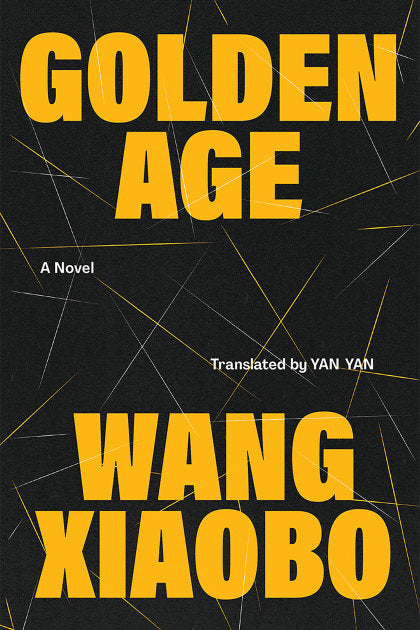
And so begins Wang Er’s story of his long affair with Chen Qinyang. Wang Er, a 21-year-old ox herder, is shamed by the local authorities and forced to write a confession for his crimes. Instead, he takes it upon himself to write a modernist literary tract. Later, as a lecturer at a chaotic, newly built university, Wang Er navigates the bureaucratic maze of 1980’s China, boldly writing about the Cultural Revolution’s impact on his life and those around him. Finally, alone and humbled, Wang Er must come to terms with the banality of his own existence.
But what makes this novel both hilarious and important is Xiaobo’s use of the awkwardness of sex as a metaphor for all that occured during the Cultural Revolution. This achievement was revolutionary in China and places Golden Age in the great pantheon of novels that argue against governmental control.
A leading icon of his generation, Wang Xiaobo’s cerebral and sarcastic narrative is a reflection on the failures of individuals and the enormous political, social, and personal changes in twentieth-century China.
STANDARD, PRIMARY, DM AND VARIANT COVERS
Standard and Primary covers are widely available through general retailers. They often have higher print runs and can be cheaper, especially during sales.
In contrast, Direct Market (DM) and variant covers are primarily sold in comic shops. DM editions tend to have more limited availability and may be more valuable to collectors.
The main differences lie in artwork style, availability, price, and collector appeal. Ultimately, the choice between standard and variant covers depends on personal preference, budget, and individual collecting goals.
PRODUCT TYPES
Comic book enthusiasts have various formats to choose from when collecting their favorite stories.
Here's a brief overview of the main types:
Omnibus
- Large, hardcover collections
- Usually contain complete runs or extensive story arcs
- Typically 800-1000+ pages
- Higher price point, often €100-€150
Oversized Hardcover (OHC)
- Similar dimensions to omnibus, but thinner
- Collect shorter runs or story arcs
- Usually 300-600 pages
- Priced between €30-€50
Hardcover (HC)
- Standard-sized hardcover books
- Collect 6-12 issues typically
- Similar dimensions to single issues, but with a hard cover
- Priced around €25-€35
Trade Paperback (TP)
- Softcover collections
- Standard comic book size
- Usually collect 4-6 issues
- Most affordable option, typically €15-€25
Other Formats
- Absolute Editions: Oversized, deluxe hardcovers (mainly DC Comics)
- Compendiums: Massive paperback collections
- Graphic Novels (OGN/GN): Original stories not previously released as single issues
The choice between these formats often depends on personal preference, budget, and collecting goals. Omnibus and OHC editions offer larger artwork and more content but at a higher price, while TPs provide a more affordable way to collect complete story arcs