

Random House Publishing Group
Hooked
Hooked
Couldn't load pickup availability
Collapsible content
ABOUT
“The processed food industry has managed to avoid being lumped in with Big Tobacco—which is why Michael Moss’s new book is so important.”—Charles Duhigg, author of The Power of Habit
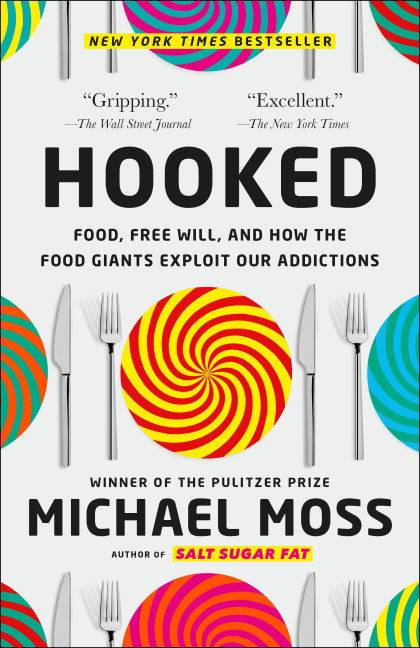
Everyone knows how hard it can be to maintain a healthy diet. But what if some of the decisions we make about what to eat are beyond our control? Is it possible that food is addictive, like drugs or alcohol? And to what extent does the food industry know, or care, about these vulnerabilities? In Hooked, Pulitzer Prize–winning investigative reporter Michael Moss sets out to answer these questions—and to find the true peril in our food.
Moss uses the latest research on addiction to uncover what the scientific and medical communities—as well as food manufacturers—already know: that food, in some cases, is even more addictive than alcohol, cigarettes, and drugs. Our bodies are hardwired for sweets, so food giants have developed fifty-six types of sugar to add to their products, creating in us the expectation that everything should be cloying; we’ve evolved to prefer fast, convenient meals, hence our modern-day preference for ready-to-eat foods. Moss goes on to show how the processed food industry—including major companies like Nestlé, Mars, and Kellogg’s—has tried not only to evade this troubling discovery about the addictiveness of food but to actually exploit it. For instance, in response to recent dieting trends, food manufacturers have simply turned junk food into junk diets, filling grocery stores with “diet” foods that are hardly distinguishable from the products that got us into trouble in the first place. As obesity rates continue to climb, manufacturers are now claiming to add ingredients that can effortlessly cure our compulsive eating habits.
A gripping account of the legal battles, insidious marketing campaigns, and cutting-edge food science that have brought us to our current public health crisis, Hooked lays out all that the food industry is doing to exploit and deepen our addictions, and shows us why what we eat has never mattered more.
STANDARD, PRIMARY, DM AND VARIANT COVERS
Standard and Primary covers are widely available through general retailers. They often have higher print runs and can be cheaper, especially during sales.
In contrast, Direct Market (DM) and variant covers are primarily sold in comic shops. DM editions tend to have more limited availability and may be more valuable to collectors.
The main differences lie in artwork style, availability, price, and collector appeal. Ultimately, the choice between standard and variant covers depends on personal preference, budget, and individual collecting goals.
PRODUCT TYPES
Comic book enthusiasts have various formats to choose from when collecting their favorite stories.
Here's a brief overview of the main types:
Omnibus
- Large, hardcover collections
- Usually contain complete runs or extensive story arcs
- Typically 800-1000+ pages
- Higher price point, often €100-€150
Oversized Hardcover (OHC)
- Similar dimensions to omnibus, but thinner
- Collect shorter runs or story arcs
- Usually 300-600 pages
- Priced between €30-€50
Hardcover (HC)
- Standard-sized hardcover books
- Collect 6-12 issues typically
- Similar dimensions to single issues, but with a hard cover
- Priced around €25-€35
Trade Paperback (TP)
- Softcover collections
- Standard comic book size
- Usually collect 4-6 issues
- Most affordable option, typically €15-€25
Other Formats
- Absolute Editions: Oversized, deluxe hardcovers (mainly DC Comics)
- Compendiums: Massive paperback collections
- Graphic Novels (OGN/GN): Original stories not previously released as single issues
The choice between these formats often depends on personal preference, budget, and collecting goals. Omnibus and OHC editions offer larger artwork and more content but at a higher price, while TPs provide a more affordable way to collect complete story arcs