

Penguin Publishing Group
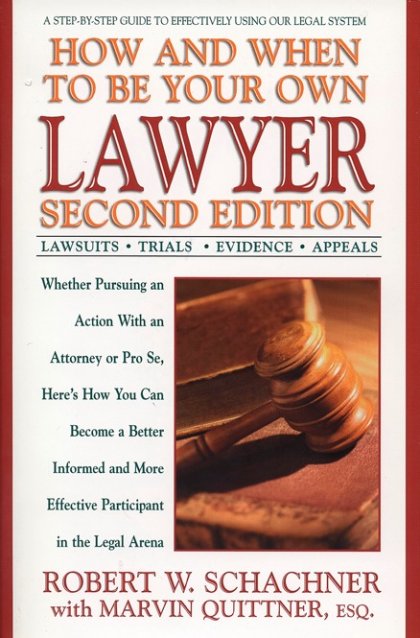
How and When to Be Your Own Lawyer
How and When to Be Your Own Lawyer
Couldn't load pickup availability
Collapsible content
ABOUT
“A valuable read for every entrepreneur. Knowing the legal system will not only put you at ease, but will immensely help in making you a better and more effective client when working with an attorney.” –Entrepreneur
If you’re having problems with a business deal that’s soured, an unresponsive landlord, or the guy who totaled your car, you can turn to the courts for relief. But if you think there is only one way to proceed, think again. In this country, there is a tradition of self-help law that is as much a part of our heritage as mom, apple pie, and the American flag. It’s called pro se—legal self-representation—and it may be the answer for you.
In this, the updated second edition of How and When to Be Your Own Lawyer—one of the most successful self-help law books ever published—authors Robert Schachner and Marvin Quittner, Esq., provide the average person with a no-nonsense guide to using the American legal system. Written in plain English, How and When to Be Your Own Lawyer leads you through the maze of legal processes principles—step by step—from making a realistic appraisal of your case to collecting a judgment. It provides information on drawing up a complaint, using a law library, devising strategy, assembling evidence, filing motions, and preparing and presenting your case in court, including advice on how to deal with an opposing attorney when proceeding pro se. The authors also offer clear explanations of legal terms and historical background that helps to make sense of many puzzling aspects of the law, all highlighted by real-life case histories.
STANDARD, PRIMARY, DM AND VARIANT COVERS
Standard and Primary covers are widely available through general retailers. They often have higher print runs and can be cheaper, especially during sales.
In contrast, Direct Market (DM) and variant covers are primarily sold in comic shops. DM editions tend to have more limited availability and may be more valuable to collectors.
The main differences lie in artwork style, availability, price, and collector appeal. Ultimately, the choice between standard and variant covers depends on personal preference, budget, and individual collecting goals.
PRODUCT TYPES
Comic book enthusiasts have various formats to choose from when collecting their favorite stories.
Here's a brief overview of the main types:
Omnibus
- Large, hardcover collections
- Usually contain complete runs or extensive story arcs
- Typically 800-1000+ pages
- Higher price point, often €100-€150
Oversized Hardcover (OHC)
- Similar dimensions to omnibus, but thinner
- Collect shorter runs or story arcs
- Usually 300-600 pages
- Priced between €30-€50
Hardcover (HC)
- Standard-sized hardcover books
- Collect 6-12 issues typically
- Similar dimensions to single issues, but with a hard cover
- Priced around €25-€35
Trade Paperback (TP)
- Softcover collections
- Standard comic book size
- Usually collect 4-6 issues
- Most affordable option, typically €15-€25
Other Formats
- Absolute Editions: Oversized, deluxe hardcovers (mainly DC Comics)
- Compendiums: Massive paperback collections
- Graphic Novels (OGN/GN): Original stories not previously released as single issues
The choice between these formats often depends on personal preference, budget, and collecting goals. Omnibus and OHC editions offer larger artwork and more content but at a higher price, while TPs provide a more affordable way to collect complete story arcs