

Harmony/Rodale/Convergent
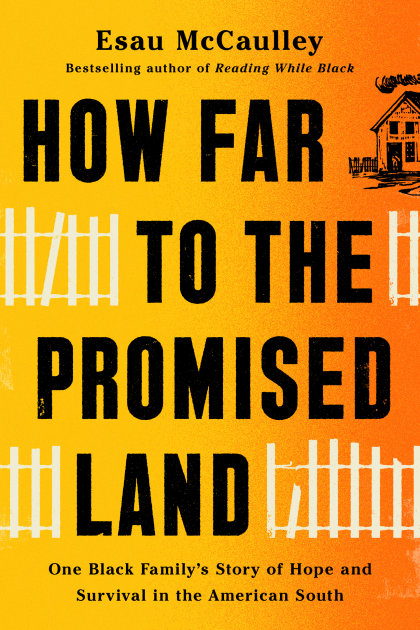
How Far to the Promised Land
How Far to the Promised Land
Couldn't load pickup availability
Collapsible content
ABOUT
“Powerful . . . McCaulley uses examples of his own family’s stories of survival over time to remind readers that some paths to the promised land have detours along the way.”—The Root
A PUBLISHERS WEEKLY BEST BOOK OF THE YEAR
For much of his life, Esau McCaulley was taught to see himself as an exception: someone who, through hard work, faith, and determination, overcame childhood poverty, anti-Black racism, and an absent father to earn a job as a university professor and a life in the middle class.
But that narrative was called into question one night, when McCaulley answered the phone and learned that his father—whose absence defined his upbringing—died in a car crash. McCaulley was being asked to deliver his father’s eulogy, to make sense of his complicated legacy in a country that only accepts Black men on the condition that they are exceptional, hardworking, perfect.
The resulting effort sent McCaulley back through his family history, seeking to understand the community that shaped him. In these pages, we meet his great-grandmother Sophia, a tenant farmer born with the gift of prophecy who scraped together a life in Jim Crow Alabama; his mother, Laurie, who raised four kids alone in an era when single Black mothers were demonized as “welfare queens”; and a cast of family, friends, and neighbors who won small victories in a world built to swallow Black lives. With profound honesty and compassion, he raises questions that implicate us all: What does each person’s struggle to build a life teach us about what we owe each other? About what it means to be human?
How Far to the Promised Land is a thrilling and tender epic about being Black in America. It’s a book that questions our too-simple narratives about poverty and upward mobility; a book in which the people normally written out of the American Dream are given voice.
STANDARD, PRIMARY, DM AND VARIANT COVERS
Standard and Primary covers are widely available through general retailers. They often have higher print runs and can be cheaper, especially during sales.
In contrast, Direct Market (DM) and variant covers are primarily sold in comic shops. DM editions tend to have more limited availability and may be more valuable to collectors.
The main differences lie in artwork style, availability, price, and collector appeal. Ultimately, the choice between standard and variant covers depends on personal preference, budget, and individual collecting goals.
PRODUCT TYPES
Comic book enthusiasts have various formats to choose from when collecting their favorite stories.
Here's a brief overview of the main types:
Omnibus
- Large, hardcover collections
- Usually contain complete runs or extensive story arcs
- Typically 800-1000+ pages
- Higher price point, often €100-€150
Oversized Hardcover (OHC)
- Similar dimensions to omnibus, but thinner
- Collect shorter runs or story arcs
- Usually 300-600 pages
- Priced between €30-€50
Hardcover (HC)
- Standard-sized hardcover books
- Collect 6-12 issues typically
- Similar dimensions to single issues, but with a hard cover
- Priced around €25-€35
Trade Paperback (TP)
- Softcover collections
- Standard comic book size
- Usually collect 4-6 issues
- Most affordable option, typically €15-€25
Other Formats
- Absolute Editions: Oversized, deluxe hardcovers (mainly DC Comics)
- Compendiums: Massive paperback collections
- Graphic Novels (OGN/GN): Original stories not previously released as single issues
The choice between these formats often depends on personal preference, budget, and collecting goals. Omnibus and OHC editions offer larger artwork and more content but at a higher price, while TPs provide a more affordable way to collect complete story arcs