

Penguin Publishing Group
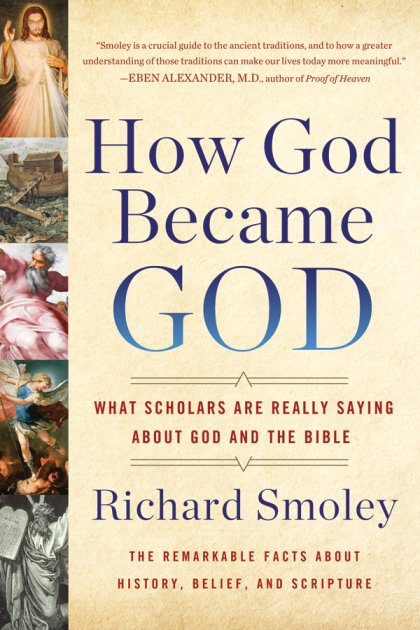
How God Became God
How God Became God
Couldn't load pickup availability
Collapsible content
ABOUT
From a historical perspective, the Bible is shockingly, provably wrong--a point supported by today's best archaeological and historical scholarship but not well understood by (or communicated to) the public. Yet this emphatically does not mean that the Bible isn't, in some very real measure, true, argues scholar of mysticism Richard Smoley.
Smoley reviews the most authoritative historical evidence to demonstrate that figures such as Moses, Abraham, and Jesus are not only unlikely to have existed, but bear strong composite resemblances to other Near Eastern religious icons. Likewise, the geopolitical and military events of Scripture fail to mesh with the largely settled historical time line and social structures. Smoley meticulously shows how our concepts of the Hebrew and Christian God, including Christ himself, are an assemblage of ideas that were altered, argued over, and edited--until their canonization. This process, to a large degree, gave Western civilization its consensus view of God.
But these conclusions are not cause for nihilism or disbelief. Rather, beneath the metaphorical figures and mythical historicism of Scripture appears an extraordinary, truly transcendent theology born from the most sacred and fully realized spiritual and human insights of the antique Eastern world. Far from being "untrue," the Bible is remarkably, extraordinarily true as it connects us to the sublime insights of our ancient ancestors and points to a unifying ethic behind many of the world's faiths.
STANDARD, PRIMARY, DM AND VARIANT COVERS
Standard and Primary covers are widely available through general retailers. They often have higher print runs and can be cheaper, especially during sales.
In contrast, Direct Market (DM) and variant covers are primarily sold in comic shops. DM editions tend to have more limited availability and may be more valuable to collectors.
The main differences lie in artwork style, availability, price, and collector appeal. Ultimately, the choice between standard and variant covers depends on personal preference, budget, and individual collecting goals.
PRODUCT TYPES
Comic book enthusiasts have various formats to choose from when collecting their favorite stories.
Here's a brief overview of the main types:
Omnibus
- Large, hardcover collections
- Usually contain complete runs or extensive story arcs
- Typically 800-1000+ pages
- Higher price point, often €100-€150
Oversized Hardcover (OHC)
- Similar dimensions to omnibus, but thinner
- Collect shorter runs or story arcs
- Usually 300-600 pages
- Priced between €30-€50
Hardcover (HC)
- Standard-sized hardcover books
- Collect 6-12 issues typically
- Similar dimensions to single issues, but with a hard cover
- Priced around €25-€35
Trade Paperback (TP)
- Softcover collections
- Standard comic book size
- Usually collect 4-6 issues
- Most affordable option, typically €15-€25
Other Formats
- Absolute Editions: Oversized, deluxe hardcovers (mainly DC Comics)
- Compendiums: Massive paperback collections
- Graphic Novels (OGN/GN): Original stories not previously released as single issues
The choice between these formats often depends on personal preference, budget, and collecting goals. Omnibus and OHC editions offer larger artwork and more content but at a higher price, while TPs provide a more affordable way to collect complete story arcs