

Fantagraphics
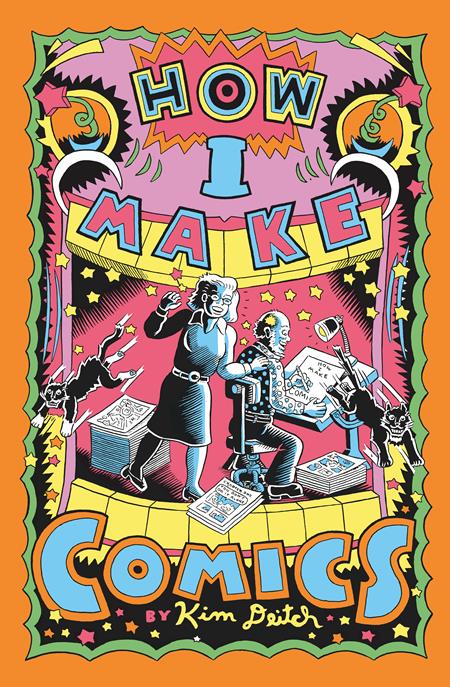
HOW I MAKE COMICS
HOW I MAKE COMICS
Couldn't load pickup availability
Collapsible content
ABOUT
How I Make Comics is not just about how Kim Deitch makes comics, but about how comics made him. The book pinwheels between real autobiography and imagined comics history, but it begins in 1952 with a true story of eight-year-old Kim Deitch appearing in the audience of the Howdy Doody Show with eight-year-old Donnie Trump. Following Donnie’s attempt to rig an election among the audience (no kidding!), Deitch relates a famous newspaper account of a diminutive wife who valiantly defends her equally diminutive husband in court, who just happens to be the inspiration of Harold Gray’s Little Orphan Annie. Periodically, Kim asks his own wife for her critique and advice of the stories he’s told so far, which he takes into account for future tales that include revenge-driven circus performers, fairytale mural painters, sordid comic book lore, comics readers creating real-life superheroes, impossibly old cats issuing supernatural judgments and inhabiting the bodies of humans, culminating in the real-life story of Kim’s mother hitchhiking across country and being picked up by none other than Forrest J. Ackerman, the sci-fi, fantasy, and monster aficionado, who takes her to a convention where she meets a teenaged Ray Bradbury. How I Make Comics is a creatively kaleidoscopic, non-stop exploration of how Deitch’s imagination turns ideas, influences, and irritations into comics in his inimitable style. Snippets of behind-the-scenes explanations of his notes and sketches expand into cascading short stories. Each section goes freewheeling from notion to notion, quietly building themes and reveling in its own wild-eyed imaginative capacities across 180 pages to form both an intimate graphic memoir and an eye-popping graphic novel. One of the most prolific artists of his generation, Deitch enters his 60th year of cartooning more inventive than ever and showing no signs of slowing down.
STANDARD, PRIMARY, DM AND VARIANT COVERS
Standard and Primary covers are widely available through general retailers. They often have higher print runs and can be cheaper, especially during sales.
In contrast, Direct Market (DM) and variant covers are primarily sold in comic shops. DM editions tend to have more limited availability and may be more valuable to collectors.
The main differences lie in artwork style, availability, price, and collector appeal. Ultimately, the choice between standard and variant covers depends on personal preference, budget, and individual collecting goals.
PRODUCT TYPES
Comic book enthusiasts have various formats to choose from when collecting their favorite stories.
Here's a brief overview of the main types:
Omnibus
- Large, hardcover collections
- Usually contain complete runs or extensive story arcs
- Typically 800-1000+ pages
- Higher price point, often €100-€150
Oversized Hardcover (OHC)
- Similar dimensions to omnibus, but thinner
- Collect shorter runs or story arcs
- Usually 300-600 pages
- Priced between €30-€50
Hardcover (HC)
- Standard-sized hardcover books
- Collect 6-12 issues typically
- Similar dimensions to single issues, but with a hard cover
- Priced around €25-€35
Trade Paperback (TP)
- Softcover collections
- Standard comic book size
- Usually collect 4-6 issues
- Most affordable option, typically €15-€25
Other Formats
- Absolute Editions: Oversized, deluxe hardcovers (mainly DC Comics)
- Compendiums: Massive paperback collections
- Graphic Novels (OGN/GN): Original stories not previously released as single issues
The choice between these formats often depends on personal preference, budget, and collecting goals. Omnibus and OHC editions offer larger artwork and more content but at a higher price, while TPs provide a more affordable way to collect complete story arcs