

Penguin Publishing Group
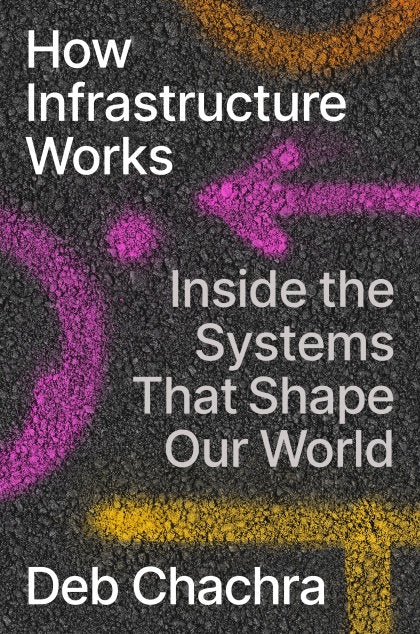
How Infrastructure Works
How Infrastructure Works
Couldn't load pickup availability
Collapsible content
ABOUT
"Revelatory, superbly written, and pulsing with wisdom and humanity, How Infrastructure Works is a masterpiece.” —Ed Yong, author of An Immense World
A new way of seeing the essential systems hidden inside our walls, under our streets, and all around us
Infrastructure is a marvel, meeting our basic needs and enabling lives of astounding ease and productivity that would have been unimaginable just a century ago. It is the physical manifestation of our social contract—of our ability to work collectively for the public good—and it consists of the most complex and vast technological systems ever created by humans.
A soaring bridge is an obvious infrastructural feat, but so are the mostly hidden reservoirs, transformers, sewers, cables, and pipes that deliver water, energy, and information to wherever we need it. When these systems work well, they hide in plain sight. Engineer and materials scientist Deb Chachra takes readers on a fascinating tour of these essential utilities, revealing how they work, what it takes to keep them running, just how much we rely on them—but also whom they work well for, and who pays the costs.
Across the U.S. and elsewhere, these systems are suffering from systemic neglect and the effects of climate change, becoming unavoidably visible when they break down. Communities that are already marginalized often bear the brunt of these failures. But Chachra maps out a path for transforming and rebuilding our shared infrastructure to be not just functional but also equitable, resilient, and sustainable. The cost of not being able to rely on these systems is unthinkably high. We need to learn how to see them—and fix them, together—before it’s too late.
STANDARD, PRIMARY, DM AND VARIANT COVERS
Standard and Primary covers are widely available through general retailers. They often have higher print runs and can be cheaper, especially during sales.
In contrast, Direct Market (DM) and variant covers are primarily sold in comic shops. DM editions tend to have more limited availability and may be more valuable to collectors.
The main differences lie in artwork style, availability, price, and collector appeal. Ultimately, the choice between standard and variant covers depends on personal preference, budget, and individual collecting goals.
PRODUCT TYPES
Comic book enthusiasts have various formats to choose from when collecting their favorite stories.
Here's a brief overview of the main types:
Omnibus
- Large, hardcover collections
- Usually contain complete runs or extensive story arcs
- Typically 800-1000+ pages
- Higher price point, often €100-€150
Oversized Hardcover (OHC)
- Similar dimensions to omnibus, but thinner
- Collect shorter runs or story arcs
- Usually 300-600 pages
- Priced between €30-€50
Hardcover (HC)
- Standard-sized hardcover books
- Collect 6-12 issues typically
- Similar dimensions to single issues, but with a hard cover
- Priced around €25-€35
Trade Paperback (TP)
- Softcover collections
- Standard comic book size
- Usually collect 4-6 issues
- Most affordable option, typically €15-€25
Other Formats
- Absolute Editions: Oversized, deluxe hardcovers (mainly DC Comics)
- Compendiums: Massive paperback collections
- Graphic Novels (OGN/GN): Original stories not previously released as single issues
The choice between these formats often depends on personal preference, budget, and collecting goals. Omnibus and OHC editions offer larger artwork and more content but at a higher price, while TPs provide a more affordable way to collect complete story arcs