

Crown
How to AI
How to AI
Couldn't load pickup availability
Collapsible content
ABOUT
“The antidote to AI panic. Read it. You’ll breathe easier.”—Scott Galloway, NYU Stern School of Business professor and co-host of Pivot with Kara Swisher
“A clear, practical, and hype-free guide to the AI revolution that will resonate with anyone trying to figure out the how to make AI deliver real value.”—Ethan Mollick, Wharton professor and New York Times bestselling author of Co-Intelligence
AI is nothing to be afraid of. After all, AI is merely software. It’s great at some things and (at least right now) terrible at others. But for workers who take time to experiment with AI and develop expertise, AI will make them more productive and more creative, saving them time, giving them job security, and boosting their income.
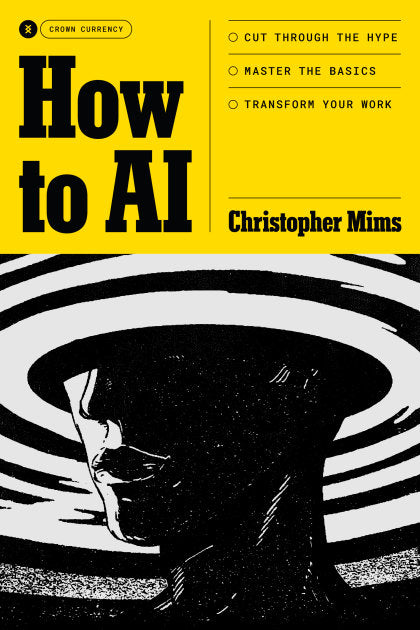
In How to AI, Wall Street Journal columnist Christopher Mims introduces readers to people just like them who are at the forefront of using AI in the world of work. Imagine a freelance lawyer who suddenly has a whip-smart assistant to help her nail every deposition. Or a mom-and-pop contractor whose new software tool is automating construction bids that used to eat up hundreds of hours.
But even as half a billion people around the world have leapt at the chance to use ChatGPT and other tools, millions of us have stayed on the sidelines. Are you one of them? Maybe you feel you should be using AI tools, but you don’t know where to begin. Or maybe you love AI but find yourself struggling to get your co-workers or employees on board. In How to AI, Mims teaches readers twenty-four simple but eye-opening “laws” about AI and how we should approach it, including:
• AI is an assistant, not a replacement.
• AI isn’t creative, but it can help you be.
• Give AI your least favorites things to do.
• AI can’t create finished products, but it’s great at prototypes.
Animated by the wit and brilliant explanatory power that have earned Mims’s Wall Street Journal columns a devoted following, How to AI will prepare readers to become a part of the AI revolution—and, most important, arm them with the tools to make it work for them.
STANDARD, PRIMARY, DM AND VARIANT COVERS
Standard and Primary covers are widely available through general retailers. They often have higher print runs and can be cheaper, especially during sales.
In contrast, Direct Market (DM) and variant covers are primarily sold in comic shops. DM editions tend to have more limited availability and may be more valuable to collectors.
The main differences lie in artwork style, availability, price, and collector appeal. Ultimately, the choice between standard and variant covers depends on personal preference, budget, and individual collecting goals.
PRODUCT TYPES
Comic book enthusiasts have various formats to choose from when collecting their favorite stories.
Here's a brief overview of the main types:
Omnibus
- Large, hardcover collections
- Usually contain complete runs or extensive story arcs
- Typically 800-1000+ pages
- Higher price point, often €100-€150
Oversized Hardcover (OHC)
- Similar dimensions to omnibus, but thinner
- Collect shorter runs or story arcs
- Usually 300-600 pages
- Priced between €30-€50
Hardcover (HC)
- Standard-sized hardcover books
- Collect 6-12 issues typically
- Similar dimensions to single issues, but with a hard cover
- Priced around €25-€35
Trade Paperback (TP)
- Softcover collections
- Standard comic book size
- Usually collect 4-6 issues
- Most affordable option, typically €15-€25
Other Formats
- Absolute Editions: Oversized, deluxe hardcovers (mainly DC Comics)
- Compendiums: Massive paperback collections
- Graphic Novels (OGN/GN): Original stories not previously released as single issues
The choice between these formats often depends on personal preference, budget, and collecting goals. Omnibus and OHC editions offer larger artwork and more content but at a higher price, while TPs provide a more affordable way to collect complete story arcs