

Random House Publishing Group
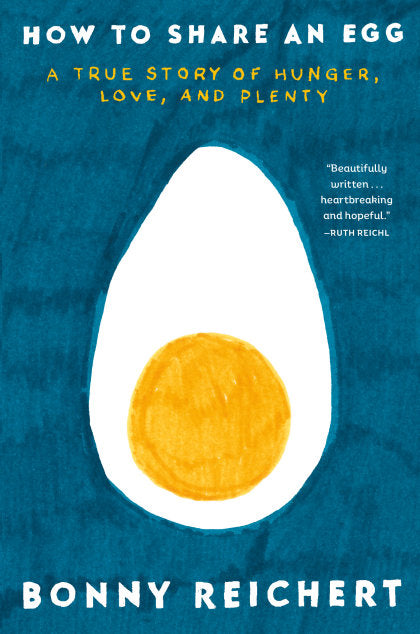
How to Share an Egg
How to Share an Egg
Couldn't load pickup availability
Collapsible content
ABOUT
“Beautifully written, heartbreaking and hopeful.”—Ruth Reichl, New York Times bestselling author of The Paris Novel
AN NPR AND THE GLOBE AND MAIL BEST BOOK OF THE YEAR
When you’re raised by someone who once survived on potato peels and coffee grounds, you develop a pretty healthy respect for food.
Bonny Reichert avoided everything to do with the Holocaust until she found herself, in midlife, suddenly typing those words into an article she was writing. The journalist had grown up hearing stories about her father’s near-starvation and ultimate survival in Auschwitz-Birkenau, but she never imagined she would be able to face this epic legacy head-on.
Then a chance encounter with a perfect bowl of borscht in Warsaw set Bonny on a journey to unearth her culinary lineage, and she began to dig for the roots of her food obsession, dish by dish. Stepping into the kitchen to connect her past with her future, the author recounts the defining moments of her life in a poignant tale of scarcity and plenty: her colorful childhood in the restaurant business, the crumbling of her first marriage and the intensity of young motherhood, her decision to become a chef, and that life-altering visit to Poland. Whether it’s the flaky potato knishes and molasses porridge bread she learned to bake at her baba Sarah’s elbow, the creamy vichyssoise she taught herself to cook in her tiny student apartment, or the brown butter eggs her father, now 93, still scrambles for her whenever she needs comfort, cuisine is both an anchor and an identity; a source of joy and a signifier of survival.
How to Share an Egg is a journey of deep flavors and surprising contrasts. By turns sweet, salty, sour, and bitter, this is one woman’s search to find her voice as a writer, chef, mother, and daughter. Do the tiny dramas of her own life matter in comparison to everything her father has seen and done? This moving exploration of heritage, inheritance, and self-discovery sets out to find the answer.
STANDARD, PRIMARY, DM AND VARIANT COVERS
Standard and Primary covers are widely available through general retailers. They often have higher print runs and can be cheaper, especially during sales.
In contrast, Direct Market (DM) and variant covers are primarily sold in comic shops. DM editions tend to have more limited availability and may be more valuable to collectors.
The main differences lie in artwork style, availability, price, and collector appeal. Ultimately, the choice between standard and variant covers depends on personal preference, budget, and individual collecting goals.
PRODUCT TYPES
Comic book enthusiasts have various formats to choose from when collecting their favorite stories.
Here's a brief overview of the main types:
Omnibus
- Large, hardcover collections
- Usually contain complete runs or extensive story arcs
- Typically 800-1000+ pages
- Higher price point, often €100-€150
Oversized Hardcover (OHC)
- Similar dimensions to omnibus, but thinner
- Collect shorter runs or story arcs
- Usually 300-600 pages
- Priced between €30-€50
Hardcover (HC)
- Standard-sized hardcover books
- Collect 6-12 issues typically
- Similar dimensions to single issues, but with a hard cover
- Priced around €25-€35
Trade Paperback (TP)
- Softcover collections
- Standard comic book size
- Usually collect 4-6 issues
- Most affordable option, typically €15-€25
Other Formats
- Absolute Editions: Oversized, deluxe hardcovers (mainly DC Comics)
- Compendiums: Massive paperback collections
- Graphic Novels (OGN/GN): Original stories not previously released as single issues
The choice between these formats often depends on personal preference, budget, and collecting goals. Omnibus and OHC editions offer larger artwork and more content but at a higher price, while TPs provide a more affordable way to collect complete story arcs