

Penguin Publishing Group
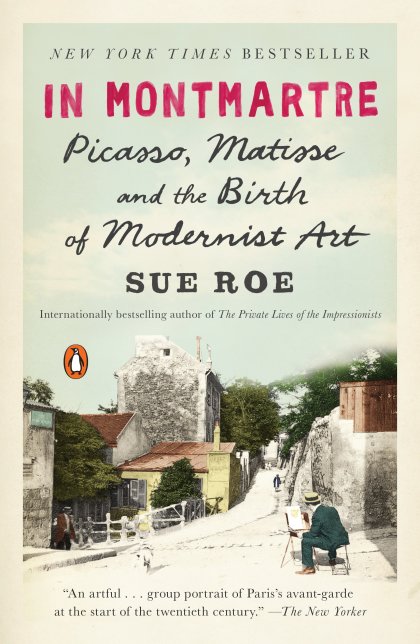
In Montmartre
In Montmartre
Couldn't load pickup availability
Collapsible content
ABOUT
A lively and deeply researched group biography of the vibrant figures who invented modernist art in bohemian Paris at the dawn of the twentieth century
When the young Pablo Picasso first arrived in Paris in 1900, the most progressive young artists all lived and worked in the seedy hillside quarter of Montmartre, in the shade of the old windmills. Over the next decade, among the studios, salons, cafés, dance halls, and galleries of Montmartre, the young Spaniard joined the likes of Henri Matisse, André Derain, Maurice de Vlaminck, Georges Braque, Amedeo Modigliani, Constantin Brancusi, Gertrude Stein, and many more in revolutionizing artistic expression.
Blending exceptional scholarship with graceful prose, Sue Roe paints a remarkable group portrait of the men and women who profoundly changed the arts of painting, sculpture, dance, music, literature, and fashion. She describes the origins of such movements as Fauvism, Cubism, and Futurism, and reconstructs the stories behind immortal paintings by Picasso and Matisse. She shows how daily life in Montmartre—which brought artists together with acrobats and dancers, prostitutes and clowns—provided an essential cauldron for artistic experimentation and for the colorful relationships, friendships, loyalties, and feuds that gave rise to some of the most pathbreaking and lasting works of the twentieth century.
In Montmartre is a thrilling account of an extraordinary group of artists on the cusp of fame and immortality that brings vividly to life one of the key moments in the history of modern art.
Praise for In Montmartre:
“A lively and concise account . . . [Roe is] very good at synthesizing and distilling complicated art movements and ideas without getting bogged down in technical details or jargon. And she offers up plenty of juicy tidbits about the artists’ love affairs, infidelities, opium parties, and eccentric habits. . . . Roe’s book is a great introduction to one of the most pivotal periods in 20th century art. Even those familiar with the era will likely find that it broadens their understanding of key players and events.” —Associated Press
STANDARD, PRIMARY, DM AND VARIANT COVERS
Standard and Primary covers are widely available through general retailers. They often have higher print runs and can be cheaper, especially during sales.
In contrast, Direct Market (DM) and variant covers are primarily sold in comic shops. DM editions tend to have more limited availability and may be more valuable to collectors.
The main differences lie in artwork style, availability, price, and collector appeal. Ultimately, the choice between standard and variant covers depends on personal preference, budget, and individual collecting goals.
PRODUCT TYPES
Comic book enthusiasts have various formats to choose from when collecting their favorite stories.
Here's a brief overview of the main types:
Omnibus
- Large, hardcover collections
- Usually contain complete runs or extensive story arcs
- Typically 800-1000+ pages
- Higher price point, often €100-€150
Oversized Hardcover (OHC)
- Similar dimensions to omnibus, but thinner
- Collect shorter runs or story arcs
- Usually 300-600 pages
- Priced between €30-€50
Hardcover (HC)
- Standard-sized hardcover books
- Collect 6-12 issues typically
- Similar dimensions to single issues, but with a hard cover
- Priced around €25-€35
Trade Paperback (TP)
- Softcover collections
- Standard comic book size
- Usually collect 4-6 issues
- Most affordable option, typically €15-€25
Other Formats
- Absolute Editions: Oversized, deluxe hardcovers (mainly DC Comics)
- Compendiums: Massive paperback collections
- Graphic Novels (OGN/GN): Original stories not previously released as single issues
The choice between these formats often depends on personal preference, budget, and collecting goals. Omnibus and OHC editions offer larger artwork and more content but at a higher price, while TPs provide a more affordable way to collect complete story arcs