

Catapult
In the Country of Women
In the Country of Women
Couldn't load pickup availability
Collapsible content
ABOUT
“Straight’s memoir is a lyric social history of her multiracial clan in Riverside that explores the bonds of love and survival that bind them, with a particular emphasis on the women’s stories . . . The aftereffect of all these disparate stories juxtaposed in a single epic is remarkable. Its resonance lingers for days after reading.” —San Francisco Chronicle
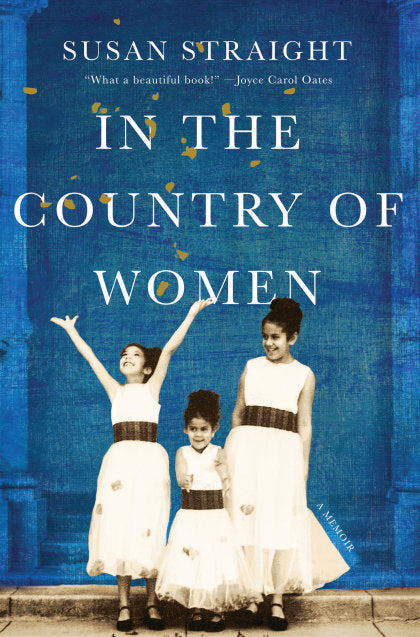
In the Country of Women is a valuable social history and a personal narrative that reads like a love song to America and indomitable women. In inland Southern California, near the desert and the Mexican border, Susan Straight, a self–proclaimed book nerd, and Dwayne Sims, an African American basketball player, started dating in high school. After college, they married and drove to Amherst, Massachusetts, where Straight met her teacher and mentor, James Baldwin, who encouraged her to write. Once back in Riverside, at driveway barbecues and fish fries with the large, close–knit Sims family, Straight—and eventually her three daughters—heard for decades the stories of Dwayne’s female ancestors. Some women escaped violence in post–slavery Tennessee, some escaped murder in Jim Crow Mississippi, and some fled abusive men. Straight’s mother–in–law, Alberta Sims, is the descendant at the heart of this memoir. Susan’s family, too, reflects the hardship and resilience of women pushing onward—from Switzerland, Canada, and the Colorado Rockies to California.
A Pakistani word, biraderi, is one Straight uses to define a complex system of kinship and clan—those who become your family. An entire community helped raise her daughters. Of her three girls, now grown and working in museums and the entertainment industry, Straight writes, “The daughters of our ancestors carry in their blood at least three continents. We are not about borders. We are about love and survival.”
“Certain books give off the sense that you won’t want them to end, so splendid the writing, so lyrical the stories. Such is the case with Southern California novelist Susan Straight’s new memoir, In the Country of Women . . . Her vibrant pages are filled with people of churned–together blood culled from scattered immigrants and native peoples, indomitable women and their babies. Yet they never succumb . . . Straight gives us permission to remember what went before with passion and attachment.” ––Los Angeles Times
STANDARD, PRIMARY, DM AND VARIANT COVERS
Standard and Primary covers are widely available through general retailers. They often have higher print runs and can be cheaper, especially during sales.
In contrast, Direct Market (DM) and variant covers are primarily sold in comic shops. DM editions tend to have more limited availability and may be more valuable to collectors.
The main differences lie in artwork style, availability, price, and collector appeal. Ultimately, the choice between standard and variant covers depends on personal preference, budget, and individual collecting goals.
PRODUCT TYPES
Comic book enthusiasts have various formats to choose from when collecting their favorite stories.
Here's a brief overview of the main types:
Omnibus
- Large, hardcover collections
- Usually contain complete runs or extensive story arcs
- Typically 800-1000+ pages
- Higher price point, often €100-€150
Oversized Hardcover (OHC)
- Similar dimensions to omnibus, but thinner
- Collect shorter runs or story arcs
- Usually 300-600 pages
- Priced between €30-€50
Hardcover (HC)
- Standard-sized hardcover books
- Collect 6-12 issues typically
- Similar dimensions to single issues, but with a hard cover
- Priced around €25-€35
Trade Paperback (TP)
- Softcover collections
- Standard comic book size
- Usually collect 4-6 issues
- Most affordable option, typically €15-€25
Other Formats
- Absolute Editions: Oversized, deluxe hardcovers (mainly DC Comics)
- Compendiums: Massive paperback collections
- Graphic Novels (OGN/GN): Original stories not previously released as single issues
The choice between these formats often depends on personal preference, budget, and collecting goals. Omnibus and OHC editions offer larger artwork and more content but at a higher price, while TPs provide a more affordable way to collect complete story arcs