

Knopf Doubleday Publishing Group
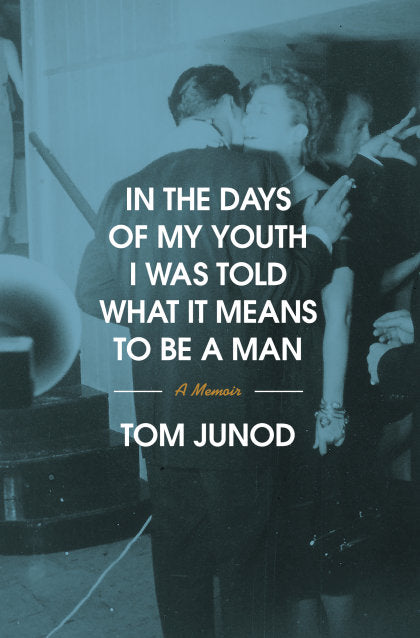
In the Days of My Youth I Was Told What It Means to Be a Man
In the Days of My Youth I Was Told What It Means to Be a Man
Couldn't load pickup availability
Collapsible content
ABOUT
“Affecting. . . . Moves like a song, drawing you in with its melody before delivering an emotional wallop.” —The New York Times
Big Lou Junod dominated every room he entered. He worshipped the sun and the sea, his own bronzed body, Frank Sinatra, and beautiful women. He was a successful traveling handbag salesman who carried himself like a celebrity. He’d return from the road with stories of going to nightclubs where the stars—Ava Gardner, maybe Liz Taylor—“couldn’t keep their eyes off . . . your father.” He had countless affairs and didn’t do much to hide them.
Lou could be cruel to Fran, his wife of fifty-nine years, but he loved his youngest son. Tom was a skin-and-bones, nervous boy, devoted to his mother, but Lou sought to turn him into a version of himself. He showered him with advice about how to dress (“A turtleneck is the most flattering thing a man can wear”), how to be an alpha male, and especially, how to attract and bed women. His parting speech when Tom went to college was: “Do yourself a favor and date a Jewish girl. They’re all nymphos.”
Tom wrestled with Lou’s imposing presence all his life. When one of Lou’s mistresses stood up at his funeral and announced, “Can we all . . . just agree . . . that this . . . was a man,” Tom set off to learn the facts of his father’s life, and why he was the way he was. The stunning secrets he uncovered—about his father, his father’s lovers, and deceptions going back generations—staggered Tom, but in the process allowed him, at last, to become his own man, by his own lights.
In the Days of My Youth I Was Told What It Means to Be a Man is an intensely emotional detective story powered by a series of cascading revelations. The book is a triumph of bravura writing; it is a tale of a son reckoning with the consequences of his father’s life, and in the end, the story of the son’s redemption.
STANDARD, PRIMARY, DM AND VARIANT COVERS
Standard and Primary covers are widely available through general retailers. They often have higher print runs and can be cheaper, especially during sales.
In contrast, Direct Market (DM) and variant covers are primarily sold in comic shops. DM editions tend to have more limited availability and may be more valuable to collectors.
The main differences lie in artwork style, availability, price, and collector appeal. Ultimately, the choice between standard and variant covers depends on personal preference, budget, and individual collecting goals.
PRODUCT TYPES
Comic book enthusiasts have various formats to choose from when collecting their favorite stories.
Here's a brief overview of the main types:
Omnibus
- Large, hardcover collections
- Usually contain complete runs or extensive story arcs
- Typically 800-1000+ pages
- Higher price point, often €100-€150
Oversized Hardcover (OHC)
- Similar dimensions to omnibus, but thinner
- Collect shorter runs or story arcs
- Usually 300-600 pages
- Priced between €30-€50
Hardcover (HC)
- Standard-sized hardcover books
- Collect 6-12 issues typically
- Similar dimensions to single issues, but with a hard cover
- Priced around €25-€35
Trade Paperback (TP)
- Softcover collections
- Standard comic book size
- Usually collect 4-6 issues
- Most affordable option, typically €15-€25
Other Formats
- Absolute Editions: Oversized, deluxe hardcovers (mainly DC Comics)
- Compendiums: Massive paperback collections
- Graphic Novels (OGN/GN): Original stories not previously released as single issues
The choice between these formats often depends on personal preference, budget, and collecting goals. Omnibus and OHC editions offer larger artwork and more content but at a higher price, while TPs provide a more affordable way to collect complete story arcs