

Penguin Publishing Group
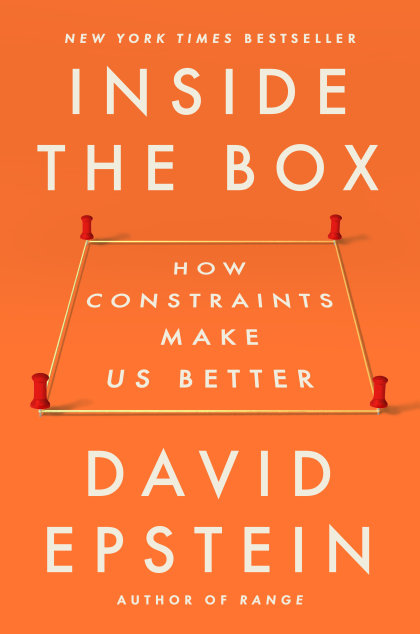
Inside the Box
Inside the Box
Couldn't load pickup availability
Collapsible content
ABOUT
"Fascinating stories. . . . Boxing ourselves in may be the ultimate way to think outside the box." —Wall Street Journal
“I thought David Epstein’s first two books were brilliant, but Inside the Box is his best. I’ll never think about my own work the same way again.” —Malcolm Gladwell
It's never been easier to do too much. From the #1 New York Times bestselling author of Range, why limits are the key to stimulating creativity, innovation, collaboration, and personal contentment.
We live in a world that gives us seemingly infinite choices and prizes freedom above all else. We have an unprecedented number of options regarding what to do, who to be, and how to spend our time. All that choice is wonderful; it is also overwhelming. The irony is that total freedom can be paralyzing, and unlimited resources don’t necessarily lead to the biggest breakthroughs. In fact, overvaluing complete freedom can be disastrous for everything from starting a company to harnessing creativity to finding personal satisfaction.
David Epstein argues that all of us—individuals, businesses, institutions, even societies—can benefit from narrowing our options. He dives into the science and practice of constraints, exploring exactly when and how guardrails can be beneficial, whether we’re working with limited resources or using self-imposed boundaries to tap unexpected wells of focus and innovation.
Original, galvanizing, and deeply researched, Inside the Box tells absorbing stories of people and organizations that embraced constraints to transform themselves, and the world—as well as a few that struggled from a lack of limits. Epstein reveals how boundaries create breakthroughs, and how setting the right constraints can help you become the most creative, productive, and satisfied version of yourself.
STANDARD, PRIMARY, DM AND VARIANT COVERS
Standard and Primary covers are widely available through general retailers. They often have higher print runs and can be cheaper, especially during sales.
In contrast, Direct Market (DM) and variant covers are primarily sold in comic shops. DM editions tend to have more limited availability and may be more valuable to collectors.
The main differences lie in artwork style, availability, price, and collector appeal. Ultimately, the choice between standard and variant covers depends on personal preference, budget, and individual collecting goals.
PRODUCT TYPES
Comic book enthusiasts have various formats to choose from when collecting their favorite stories.
Here's a brief overview of the main types:
Omnibus
- Large, hardcover collections
- Usually contain complete runs or extensive story arcs
- Typically 800-1000+ pages
- Higher price point, often €100-€150
Oversized Hardcover (OHC)
- Similar dimensions to omnibus, but thinner
- Collect shorter runs or story arcs
- Usually 300-600 pages
- Priced between €30-€50
Hardcover (HC)
- Standard-sized hardcover books
- Collect 6-12 issues typically
- Similar dimensions to single issues, but with a hard cover
- Priced around €25-€35
Trade Paperback (TP)
- Softcover collections
- Standard comic book size
- Usually collect 4-6 issues
- Most affordable option, typically €15-€25
Other Formats
- Absolute Editions: Oversized, deluxe hardcovers (mainly DC Comics)
- Compendiums: Massive paperback collections
- Graphic Novels (OGN/GN): Original stories not previously released as single issues
The choice between these formats often depends on personal preference, budget, and collecting goals. Omnibus and OHC editions offer larger artwork and more content but at a higher price, while TPs provide a more affordable way to collect complete story arcs