

Random House Publishing Group
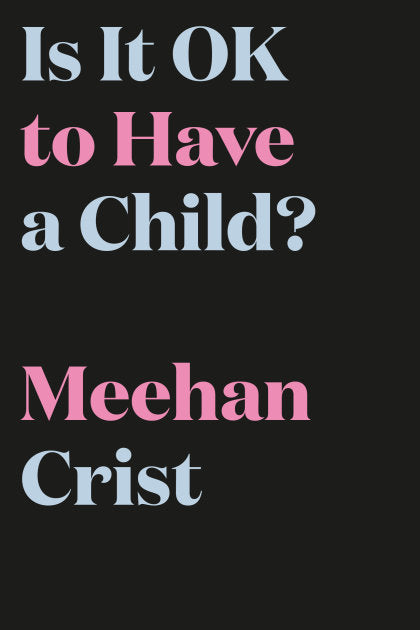
Is It OK to Have a Child?
Is It OK to Have a Child?
Couldn't load pickup availability
Collapsible content
ABOUT
When Meehan Crist was eight months pregnant, a young woman asked her a difficult question—knowing what you know about the climate crisis, how does it feel to be pregnant?
As we face overlapping environmental crises, a profoundly uncertain future is reshaping how people think about having babies. Having a child is at once the most intimate thing a person can do and an unavoidably political act that raises some deeply troubling questions: What will life be like for someone born into this increasingly unstable world? Will adding another human to the global population be an unconscionable burden to place on the planet? Are these even the right questions to be asking?
In reality, Crist shows us, we’ve inherited a thorny debate about population that is resurfacing at a time when population is rising, fertility rates are falling, and environmental concerns are growing. This chaotic convergence threatens reproductive freedoms and snarls efforts to form a coherent vision for a stable ecological and political future. To help us make sense of all this, Crist sheds light on the way corporations and governments shift responsibility for climate crisis onto individuals, eugenicists mask racism in the guise of science, and why efforts to link fertility to environmental crisis arising across the political map—from far left to far right—should concern us all. Ultimately, Crist argues, sustainability must be built at the level of society itself: it is human systems, rather than human families, that need to be reimagined.
Is It OK to Have a Child? is for anyone who has asked this question—and a radical invitation to fight for the possibility of better futures for us all.
STANDARD, PRIMARY, DM AND VARIANT COVERS
Standard and Primary covers are widely available through general retailers. They often have higher print runs and can be cheaper, especially during sales.
In contrast, Direct Market (DM) and variant covers are primarily sold in comic shops. DM editions tend to have more limited availability and may be more valuable to collectors.
The main differences lie in artwork style, availability, price, and collector appeal. Ultimately, the choice between standard and variant covers depends on personal preference, budget, and individual collecting goals.
PRODUCT TYPES
Comic book enthusiasts have various formats to choose from when collecting their favorite stories.
Here's a brief overview of the main types:
Omnibus
- Large, hardcover collections
- Usually contain complete runs or extensive story arcs
- Typically 800-1000+ pages
- Higher price point, often €100-€150
Oversized Hardcover (OHC)
- Similar dimensions to omnibus, but thinner
- Collect shorter runs or story arcs
- Usually 300-600 pages
- Priced between €30-€50
Hardcover (HC)
- Standard-sized hardcover books
- Collect 6-12 issues typically
- Similar dimensions to single issues, but with a hard cover
- Priced around €25-€35
Trade Paperback (TP)
- Softcover collections
- Standard comic book size
- Usually collect 4-6 issues
- Most affordable option, typically €15-€25
Other Formats
- Absolute Editions: Oversized, deluxe hardcovers (mainly DC Comics)
- Compendiums: Massive paperback collections
- Graphic Novels (OGN/GN): Original stories not previously released as single issues
The choice between these formats often depends on personal preference, budget, and collecting goals. Omnibus and OHC editions offer larger artwork and more content but at a higher price, while TPs provide a more affordable way to collect complete story arcs