

Random House Publishing Group
Jackie Robinson
Jackie Robinson
Couldn't load pickup availability
Collapsible content
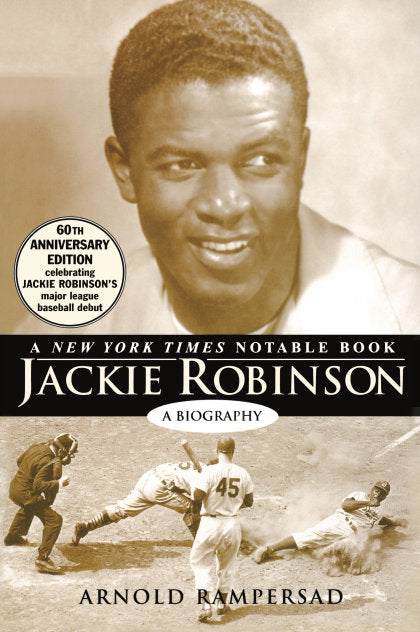
ABOUT
Born in the rural South, the son of a sharecropper, Robinson was reared in southern California. We see him blossom there as a student-athlete as he struggled against poverty and racism to uphold the beliefs instilled in him by his mother--faith in family, education, America, and God.
We follow Robinson through World War II, when, in the first wave of racial integration in the armed forces, he was commissioned as an officer, then court-martialed after refusing to move to the back of a bus. After he plays in the Negro National League, we watch the opening of an all-American drama as, late in 1945, Branch Rickey of the Brooklyn Dodgers recognized Jack as the right player to break baseball's color barrier--and the game was forever changed.
Jack's never-before-published letters open up his relationship with his family, especially his wife, Rachel, whom he married just as his perilous venture of integrating baseball began. Her memories are a major resource of the narrative as we learn about the severe harassment Robinson endured from teammates and opponents alike; about death threats and exclusion; about joy and remarkable success. We watch his courageous response to abuse, first as a stoic endurer, then as a fighter who epitomized courage and defiance.
We see his growing friendship with white players like Pee Wee Reese and the black teammates who followed in his footsteps, and his embrace by Brooklyn's fans. We follow his blazing career: 1947, Rookie of the Year; 1949, Most Valuable Player; six pennants in ten seasons, and 1962, induction into the Hall of Fame.
But sports were merely one aspect of his life. We see his business ventures, his leading role in the community, his early support of Martin Luther King Jr., his commitment to the civil rights movement at a crucial stage in its evolution; his controversial associations with Eisenhower, Kennedy, Nixon, Humphrey, Goldwater, Nelson Rockefeller, and Malcolm X.
Rampersad's magnificent biography leaves us with an indelible image of a principled man who was passionate in his loyalties and opinions: a baseball player who could focus a crowd's attention as no one before or since; an activist at the crossroads of his people's struggle; a dedicated family man whose last years were plagued by illness and tragedy, and who died prematurely at fifty-two. He was a pathfinder, an American hero, and he now has the biography he deserves.
STANDARD, PRIMARY, DM AND VARIANT COVERS
Standard and Primary covers are widely available through general retailers. They often have higher print runs and can be cheaper, especially during sales.
In contrast, Direct Market (DM) and variant covers are primarily sold in comic shops. DM editions tend to have more limited availability and may be more valuable to collectors.
The main differences lie in artwork style, availability, price, and collector appeal. Ultimately, the choice between standard and variant covers depends on personal preference, budget, and individual collecting goals.
PRODUCT TYPES
Comic book enthusiasts have various formats to choose from when collecting their favorite stories.
Here's a brief overview of the main types:
Omnibus
- Large, hardcover collections
- Usually contain complete runs or extensive story arcs
- Typically 800-1000+ pages
- Higher price point, often €100-€150
Oversized Hardcover (OHC)
- Similar dimensions to omnibus, but thinner
- Collect shorter runs or story arcs
- Usually 300-600 pages
- Priced between €30-€50
Hardcover (HC)
- Standard-sized hardcover books
- Collect 6-12 issues typically
- Similar dimensions to single issues, but with a hard cover
- Priced around €25-€35
Trade Paperback (TP)
- Softcover collections
- Standard comic book size
- Usually collect 4-6 issues
- Most affordable option, typically €15-€25
Other Formats
- Absolute Editions: Oversized, deluxe hardcovers (mainly DC Comics)
- Compendiums: Massive paperback collections
- Graphic Novels (OGN/GN): Original stories not previously released as single issues
The choice between these formats often depends on personal preference, budget, and collecting goals. Omnibus and OHC editions offer larger artwork and more content but at a higher price, while TPs provide a more affordable way to collect complete story arcs