

Random House Publishing Group
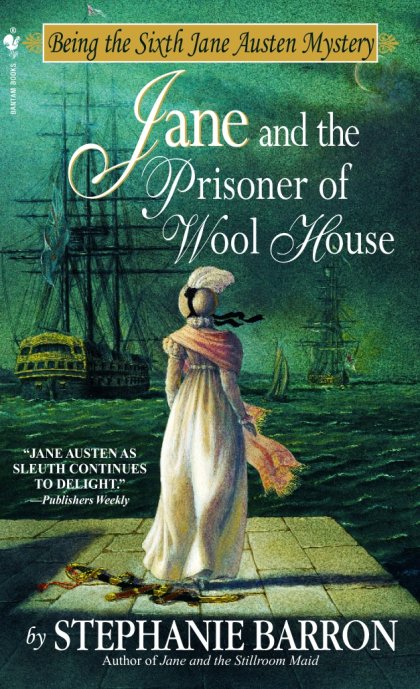
Jane and the Prisoner of Wool House
Jane and the Prisoner of Wool House
Couldn't load pickup availability
Collapsible content
ABOUT
Jane and the Prisoner of Wool House
“I will assert that sailors are endowed with greater worth than any set of men in England.”
So muses Jane Austen as she stands in the buffeting wind of Southampton’s quay beside her brother Frank on a raw February morning. Frank, a post captain in the Royal Navy, is without a ship to command, and his best prospect is the Stella Maris, a fast frigate captained by his old friend Tom Seagrave.
“Lucky” Tom — so dubbed for his habit of besting enemy ships — is presently in disgrace, charged with violating the Articles of War. Tom’s first lieutenant, Eustace Chessyre, has accused Seagrave of murder in the death of a French captain after the surrender of his ship.
Though Lucky Tom denies the charge, his dagger was found in the dead man’s chest. Now Seagrave faces court-martial and execution for a crime he swears he did not commit.
Frank, deeply grieved, is certain his friend will hang. But Jane reasons that either Seagrave or Chessyre is lying — and that she and Frank have a duty to discover the truth.
The search for the captain’s honor carries them into the troubled heart of Seagrave’s family, through some of the seaport’s worst sinkholes, and at long last to Wool House, the barred brick structure that serves as gaol for French prisoners of war.
Risking contagion or worse, Jane agrees to nurse the murdered French captain’s imprisoned crew — and elicits a debonair surgeon’s account of the Stella Maris’s battle that appears to clear Tom Seagrave of all guilt.
When Eustace Chessyre is found murdered, the entire affair takes on the appearance of an insidious plot against Seagrave, who is charged with the crime. Could any of his naval colleagues wish him dead? In an era of turbulent intrigue and contested amour, could it be a case of cherchez la femme ... or a veiled political foe at work? And what of the sealed orders under which Seagrave embarked that fateful night in the Stella Maris? Death knocks again at Jane’s own door before the final knots in the killer’s net are completely untangled.
Always surprising, Jane and the Prisoner of Wool House is an intelligent and intriguing mystery that introduces Jane and her readers to “the naval set” — and charts a true course through the amateur sleuth’s most troubled waters yet.
STANDARD, PRIMARY, DM AND VARIANT COVERS
Standard and Primary covers are widely available through general retailers. They often have higher print runs and can be cheaper, especially during sales.
In contrast, Direct Market (DM) and variant covers are primarily sold in comic shops. DM editions tend to have more limited availability and may be more valuable to collectors.
The main differences lie in artwork style, availability, price, and collector appeal. Ultimately, the choice between standard and variant covers depends on personal preference, budget, and individual collecting goals.
PRODUCT TYPES
Comic book enthusiasts have various formats to choose from when collecting their favorite stories.
Here's a brief overview of the main types:
Omnibus
- Large, hardcover collections
- Usually contain complete runs or extensive story arcs
- Typically 800-1000+ pages
- Higher price point, often €100-€150
Oversized Hardcover (OHC)
- Similar dimensions to omnibus, but thinner
- Collect shorter runs or story arcs
- Usually 300-600 pages
- Priced between €30-€50
Hardcover (HC)
- Standard-sized hardcover books
- Collect 6-12 issues typically
- Similar dimensions to single issues, but with a hard cover
- Priced around €25-€35
Trade Paperback (TP)
- Softcover collections
- Standard comic book size
- Usually collect 4-6 issues
- Most affordable option, typically €15-€25
Other Formats
- Absolute Editions: Oversized, deluxe hardcovers (mainly DC Comics)
- Compendiums: Massive paperback collections
- Graphic Novels (OGN/GN): Original stories not previously released as single issues
The choice between these formats often depends on personal preference, budget, and collecting goals. Omnibus and OHC editions offer larger artwork and more content but at a higher price, while TPs provide a more affordable way to collect complete story arcs