

Library of America
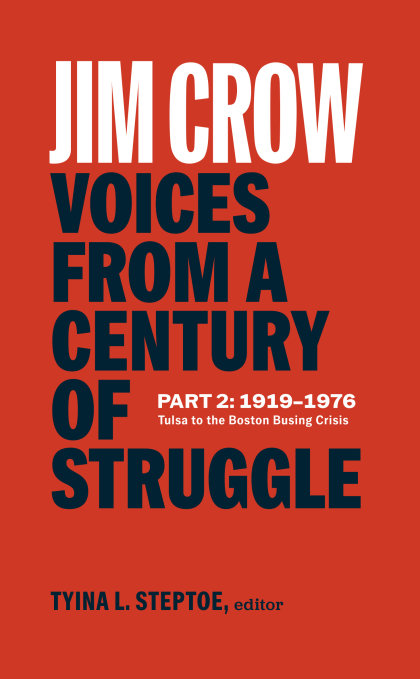
Jim Crow: Voices from a Century of Struggle Part 2 (LOA #387)
Jim Crow: Voices from a Century of Struggle Part 2 (LOA #387)
Couldn't load pickup availability
Collapsible content
ABOUT
W.E.B. Du Bois famously identified "the problem of the color-line" as the defining issue in American life. The powerful writings gathered here reveal the many ways Americans, Black and white, fought against white supremacist efforts to police the color line, envisioning a better America in the face of disenfranchisement, segregation, and widespread lynching, mob violence, and police brutality.
Jim Crow: Voices from a Century of Struggle, Part Two brings together speeches, pamphlets, newspaper and magazine articles, public testimony and appeals, judicial opinions, and poems and song lyrics—more than ninety essential texts in all—from the end of the bloody “Red Summer” of 1919 to the Boston busing crisis of 1974–76.
This volume includes writing by both famous and lesser known individuals, including
• B. C. Franklin on the Tulsa Massacre
• Robert Russa Moton’s suppressed address on the dedication of the Lincoln Memorial
• Alain Locke’s tribute to “the New Negro”
• Ned Cobb’s recounting of the harsh realities of sharecropping
• Thurgood Marshall on police brutality in wartime Detroit
• Rosa Parks’s appeal for justice for Recy Taylor
• Earl Warren’s landmark opinion in Brown
• Paul Robeson’s defiant response to congressional inquisitors
• Fannie Lou Hamer’s eloquent challenge to disenfranchisement in Mississippi
• and James Baldwin on the myths and meaning of the American Dream
Also presented are white supremacist writings from the 1920s Klan and the Dixiecrats of 1948; examples of Southern voter literacy tests; blues lyrics sung by Bessie Smith and Big Bill Broonzy; Robert F. Williams’s controversial call for armed Black self-defense; speeches by Marcus Garvey and Stokeley Carmichael; letters in the Black press about Confederate monuments; Ann Moody on her childhood in segregated Mississippi; and Mary McLeod Bethune’s advocacy for reproductive rights as an essential element of democratic freedom.
As the teaching of our nation’s history, especially the history of race in America, becomes increasingly contested, this book will serve as a vital resource, a crucial reminder of where we’ve been, how far we’ve come, and how long the road ahead remains.
STANDARD, PRIMARY, DM AND VARIANT COVERS
Standard and Primary covers are widely available through general retailers. They often have higher print runs and can be cheaper, especially during sales.
In contrast, Direct Market (DM) and variant covers are primarily sold in comic shops. DM editions tend to have more limited availability and may be more valuable to collectors.
The main differences lie in artwork style, availability, price, and collector appeal. Ultimately, the choice between standard and variant covers depends on personal preference, budget, and individual collecting goals.
PRODUCT TYPES
Comic book enthusiasts have various formats to choose from when collecting their favorite stories.
Here's a brief overview of the main types:
Omnibus
- Large, hardcover collections
- Usually contain complete runs or extensive story arcs
- Typically 800-1000+ pages
- Higher price point, often €100-€150
Oversized Hardcover (OHC)
- Similar dimensions to omnibus, but thinner
- Collect shorter runs or story arcs
- Usually 300-600 pages
- Priced between €30-€50
Hardcover (HC)
- Standard-sized hardcover books
- Collect 6-12 issues typically
- Similar dimensions to single issues, but with a hard cover
- Priced around €25-€35
Trade Paperback (TP)
- Softcover collections
- Standard comic book size
- Usually collect 4-6 issues
- Most affordable option, typically €15-€25
Other Formats
- Absolute Editions: Oversized, deluxe hardcovers (mainly DC Comics)
- Compendiums: Massive paperback collections
- Graphic Novels (OGN/GN): Original stories not previously released as single issues
The choice between these formats often depends on personal preference, budget, and collecting goals. Omnibus and OHC editions offer larger artwork and more content but at a higher price, while TPs provide a more affordable way to collect complete story arcs