

Knopf Doubleday Publishing Group
Joe Beef: Surviving the Apocalypse
Joe Beef: Surviving the Apocalypse
Couldn't load pickup availability
Collapsible content
ABOUT
“The first Joe Beef cookbook changed forever what a cookbook could be. Anything that came after had to take it into account. Now, with this latest and even more magnificent beast, the rogue princes of Canadian cuisine and hospitality show us the way out of the numbing, post-apocalyptic restaurant Hell of pretentiousness and mediocrity that threatens to engulf us all. It makes us believe that the future is shiny, bright, beautiful, delicious—and probably Québécois. This book will change your life.” —Anthony Bourdain
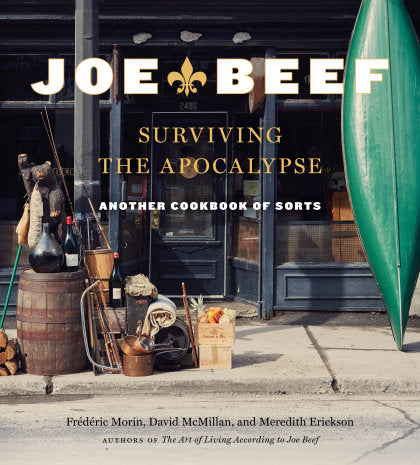
It’s the end of the world as we know it. Or not. Either way, you want Joe Beef: Surviving the Apocalypse in your bunker and/or kitchen.
In their much-loved first cookbook, Frédéric Morin, David McMillan, and Meredith Erickson introduced readers to the art of living the Joe Beef way. Now, they’re back with another deeply personal, refreshingly unpretentious collection of more than 150 new recipes, some taken directly from the menus of Fred and Dave’s acclaimed Montreal restaurants, others from summers spent on Laurentian lakes and Sunday dinners at home. Think Watercress Soup with Trout Quenelles, Artichokes Bravas, and seasonal variations on Pot-au-Feu—alongside Smoked Meat Croquettes, a Tater Tot Galette, and Squash Sticky Buns.
Also included are instructions for making your own soap and cough drops, not to mention an epic 16-page fold-out gatefold with recipes and guidance for stocking a cellar with apocalyptic essentials (Canned Bread, Pickled Pork Butt, and Smoked Apple Cider Vinegar) for throwing the most sought-after in-bunker dinner party
Filled with recipes, reflections, and ramblings, in this book you’ll find chapters devoted to the Québécois tradition of celebrating Christmas in July, the magic of public television, and Fred and Dave’s unique take on barbecue (Burnt-End Bourguignon, Cassoulet Rapide), as well as ruminations on natural wine and gluten-free cooking, and advice on how children should behave at dinner.
Whether you’re holing up for a zombie holocaust or just cooking at home, Joe Beef is a book about doing it yourself, about making it on your own, and about living—or at least surviving—in style.
STANDARD, PRIMARY, DM AND VARIANT COVERS
Standard and Primary covers are widely available through general retailers. They often have higher print runs and can be cheaper, especially during sales.
In contrast, Direct Market (DM) and variant covers are primarily sold in comic shops. DM editions tend to have more limited availability and may be more valuable to collectors.
The main differences lie in artwork style, availability, price, and collector appeal. Ultimately, the choice between standard and variant covers depends on personal preference, budget, and individual collecting goals.
PRODUCT TYPES
Comic book enthusiasts have various formats to choose from when collecting their favorite stories.
Here's a brief overview of the main types:
Omnibus
- Large, hardcover collections
- Usually contain complete runs or extensive story arcs
- Typically 800-1000+ pages
- Higher price point, often €100-€150
Oversized Hardcover (OHC)
- Similar dimensions to omnibus, but thinner
- Collect shorter runs or story arcs
- Usually 300-600 pages
- Priced between €30-€50
Hardcover (HC)
- Standard-sized hardcover books
- Collect 6-12 issues typically
- Similar dimensions to single issues, but with a hard cover
- Priced around €25-€35
Trade Paperback (TP)
- Softcover collections
- Standard comic book size
- Usually collect 4-6 issues
- Most affordable option, typically €15-€25
Other Formats
- Absolute Editions: Oversized, deluxe hardcovers (mainly DC Comics)
- Compendiums: Massive paperback collections
- Graphic Novels (OGN/GN): Original stories not previously released as single issues
The choice between these formats often depends on personal preference, budget, and collecting goals. Omnibus and OHC editions offer larger artwork and more content but at a higher price, while TPs provide a more affordable way to collect complete story arcs