

Library of America
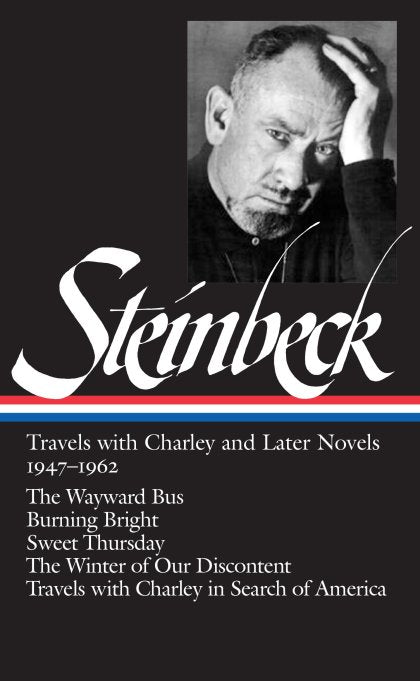
John Steinbeck: Travels with Charley and Later Novels 1947-1962 (LOA #170)
John Steinbeck: Travels with Charley and Later Novels 1947-1962 (LOA #170)
Couldn't load pickup availability
Collapsible content
ABOUT
In The Wayward Bus (1947), Steinbeck leads a group of ill-matched passengers representing a spectrum of social types and classes, stranded by a washed-out bridge, on a circuitous journey that exposes cruelties, self-deceptions, and unsuspected moral strengths. The tone ranges from boisterous comedy to trenchant satirical observation of postwar America. Burning Bright (1950), an allegory set against shifting backgrounds (circus, sea, farm) and revolving around the fear of sterility and the desire for self-perpetuation, marks Steinbeck’s involvement with the drama in its fusion of the forms of novel and play.
Sweet Thursday (1954) marks Steinbeck’s return, in a mood of sometimes frothy comedy, to the characters and milieu of his earlier Cannery Row. A love story set against the background of the local brothel, the Bear Flag, Sweet Thursday is for all its intimations of melancholy one of the most lighthearted of Steinbeck’s books. It was subsequently adapted by Rodgers and Hammerstein into their musical Pipe Dream. Steinbeck’s final novel, The Winter of Our Discontent (1961) is set in an old Long Island whaling town modeled on Sag Harbor, where he had been spending time since 1953. The book breaks new ground in its depiction of the crass commercialism of contemporary America, and its impact on a protagonist with traditionalist values who is appalled but finally tempted by the encroaching sleaziness.
Travels with Charley in Search of America (1962) was Steinbeck’s last published book. A record of his experiences and observations as he drove around America in a pickup truck, accompanied by his standard poodle Charley, it is filled with engaging, often humorous description and comes to a powerful climax in an encounter with racist demonstrators in New Orleans.
LIBRARY OF AMERICA is an independent nonprofit cultural organization founded in 1979 to preserve our nation’s literary heritage by publishing, and keeping permanently in print, America’s best and most significant writing. The Library of America series includes more than 300 volumes to date, authoritative editions that average 1,000 pages in length, feature cloth covers, sewn bindings, and ribbon markers, and are printed on premium acid-free paper that will last for centuries.
STANDARD, PRIMARY, DM AND VARIANT COVERS
Standard and Primary covers are widely available through general retailers. They often have higher print runs and can be cheaper, especially during sales.
In contrast, Direct Market (DM) and variant covers are primarily sold in comic shops. DM editions tend to have more limited availability and may be more valuable to collectors.
The main differences lie in artwork style, availability, price, and collector appeal. Ultimately, the choice between standard and variant covers depends on personal preference, budget, and individual collecting goals.
PRODUCT TYPES
Comic book enthusiasts have various formats to choose from when collecting their favorite stories.
Here's a brief overview of the main types:
Omnibus
- Large, hardcover collections
- Usually contain complete runs or extensive story arcs
- Typically 800-1000+ pages
- Higher price point, often €100-€150
Oversized Hardcover (OHC)
- Similar dimensions to omnibus, but thinner
- Collect shorter runs or story arcs
- Usually 300-600 pages
- Priced between €30-€50
Hardcover (HC)
- Standard-sized hardcover books
- Collect 6-12 issues typically
- Similar dimensions to single issues, but with a hard cover
- Priced around €25-€35
Trade Paperback (TP)
- Softcover collections
- Standard comic book size
- Usually collect 4-6 issues
- Most affordable option, typically €15-€25
Other Formats
- Absolute Editions: Oversized, deluxe hardcovers (mainly DC Comics)
- Compendiums: Massive paperback collections
- Graphic Novels (OGN/GN): Original stories not previously released as single issues
The choice between these formats often depends on personal preference, budget, and collecting goals. Omnibus and OHC editions offer larger artwork and more content but at a higher price, while TPs provide a more affordable way to collect complete story arcs