

Random House Publishing Group
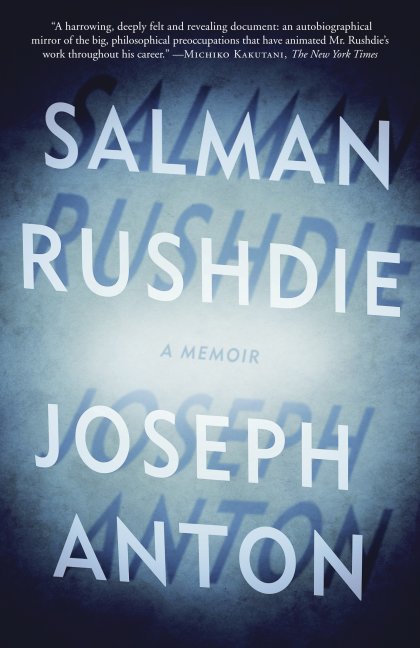
Joseph Anton
Joseph Anton
Couldn't load pickup availability
Collapsible content
ABOUT
San Francisco Chronicle • Newsweek/The Daily Beast • The Seattle Times • The Economist • Kansas City Star • BookPage
On February 14, 1989, Valentine’s Day, Salman Rushdie was telephoned by a BBC journalist and told that he had been “sentenced to death” by the Ayatollah Khomeini. For the first time he heard the word fatwa. His crime? To have written a novel called The Satanic Verses, which was accused of being “against Islam, the Prophet and the Quran.”
So begins the extraordinary story of how a writer was forced underground, moving from house to house, with the constant presence of an armed police protection team. He was asked to choose an alias that the police could call him by. He thought of writers he loved and combinations of their names; then it came to him: Conrad and Chekhov—Joseph Anton.
How do a writer and his family live with the threat of murder for more than nine years? How does he go on working? How does he fall in and out of love? How does despair shape his thoughts and actions, how and why does he stumble, how does he learn to fight back? In this remarkable memoir Rushdie tells that story for the first time; the story of one of the crucial battles, in our time, for freedom of speech. He talks about the sometimes grim, sometimes comic realities of living with armed policemen, and of the close bonds he formed with his protectors; of his struggle for support and understanding from governments, intelligence chiefs, publishers, journalists, and fellow writers; and of how he regained his freedom.
It is a book of exceptional frankness and honesty, compelling, provocative, moving, and of vital importance. Because what happened to Salman Rushdie was the first act of a drama that is still unfolding somewhere in the world every day.
Praise for Joseph Anton
“A harrowing, deeply felt and revealing document: an autobiographical mirror of the big, philosophical preoccupations that have animated Mr. Rushdie’s work throughout his career.”—Michiko Kakutani, The New York Times
“A splendid book, the finest . . . memoir to cross my desk in many a year.”—Jonathan Yardley, The Washington Post
“Thoughtful and astute . . . an important book.”—USA Today
“Compelling, affecting . . . demonstrates Mr. Rushdie’s ability as a stylist and storytelle. . . . [He] reacted with great bravery and even heroism.”—The Wall Street Journal
“Gripping, moving and entertaining . . . nothing like it has ever been written.”—The Independent (UK)
“A thriller, an epic, a political essay, a love story, an ode to liberty.”—Le Point (France)
“Action-packed . . . in a literary class by itself . . . Like Isherwood, Rushdie’s eye is a camera lens —firmly placed in one perspective and never out of focus.”—Los Angeles Review of Books
“Unflinchingly honest . . . an engrossing, exciting, revealing and often shocking book.”—de Volkskrant (The Netherlands)
“One of the best memoirs you may ever read.”—DNA (India)
“Extraordinary . . . Joseph Anton beautifully modulates between . . . moments of accidental hilarity, and the higher purpose Rushdie saw in opposing—at all costs—any curtailment on a writer’s freedom.”—The Boston Globe
STANDARD, PRIMARY, DM AND VARIANT COVERS
Standard and Primary covers are widely available through general retailers. They often have higher print runs and can be cheaper, especially during sales.
In contrast, Direct Market (DM) and variant covers are primarily sold in comic shops. DM editions tend to have more limited availability and may be more valuable to collectors.
The main differences lie in artwork style, availability, price, and collector appeal. Ultimately, the choice between standard and variant covers depends on personal preference, budget, and individual collecting goals.
PRODUCT TYPES
Comic book enthusiasts have various formats to choose from when collecting their favorite stories.
Here's a brief overview of the main types:
Omnibus
- Large, hardcover collections
- Usually contain complete runs or extensive story arcs
- Typically 800-1000+ pages
- Higher price point, often €100-€150
Oversized Hardcover (OHC)
- Similar dimensions to omnibus, but thinner
- Collect shorter runs or story arcs
- Usually 300-600 pages
- Priced between €30-€50
Hardcover (HC)
- Standard-sized hardcover books
- Collect 6-12 issues typically
- Similar dimensions to single issues, but with a hard cover
- Priced around €25-€35
Trade Paperback (TP)
- Softcover collections
- Standard comic book size
- Usually collect 4-6 issues
- Most affordable option, typically €15-€25
Other Formats
- Absolute Editions: Oversized, deluxe hardcovers (mainly DC Comics)
- Compendiums: Massive paperback collections
- Graphic Novels (OGN/GN): Original stories not previously released as single issues
The choice between these formats often depends on personal preference, budget, and collecting goals. Omnibus and OHC editions offer larger artwork and more content but at a higher price, while TPs provide a more affordable way to collect complete story arcs