

Crown
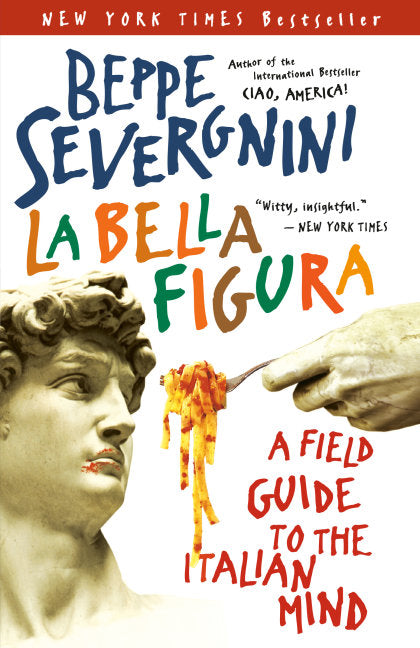
La Bella Figura
La Bella Figura
Couldn't load pickup availability
Collapsible content
ABOUT
You won’t need luggage for this hypothetical and hilarious trip into the hearts and minds of Beppe Severgnini’s fellow Italians. In fact, Beppe would prefer if you left behind the baggage his crafty and elegant countrymen have smuggled into your subconscious. To get to his Italia, you’ll need to forget about your idealized notions of Italy. Although La Bella Figura will take you to legendary cities and scenic regions, your real destinations are the places where Italians are at their best, worst, and most authentic:
The highway: in America, a red light has only one possible interpretation—Stop! An Italian red light doesn’t warn or order you as much as provide an invitation for reflection.
The airport: where Italians prove that one of their virtues (an appreciation for beauty) is really a vice. Who cares if the beautiful girls hawking cell phones in airport kiosks stick you with an outdated model? That’s the price of gazing upon perfection.
The small town: which demonstrates the Italian genius for pleasant living: “a congenial barber . . . a well-stocked newsstand . . . professionally made coffee and a proper pizza; bell towers we can recognize in the distance, and people with a kind word and a smile for everyone.”
The chaos of the roads, the anarchy of the office, the theatrical spirit of the hypermarkets, and garrulous train journeys; the sensory reassurance of a church and the importance of the beach; the solitude of the soccer stadium and the crowded Italian bedroom; the vertical fixations of the apartment building and the horizontal democracy of the eat-in kitchen. As you venture to these and many other locations rooted in the Italian psyche, you realize that Beppe has become your Dante and shown you a country that “has too much style to be hell” but is “too disorderly to be heaven.”
Ten days, thirty places. From north to south. From food to politics. From saintliness to sexuality. This ironic, methodical, and sentimental examination will help you understand why Italy—as Beppe says—“can have you fuming and then purring in the space of a hundred meters or ten minutes.”
STANDARD, PRIMARY, DM AND VARIANT COVERS
Standard and Primary covers are widely available through general retailers. They often have higher print runs and can be cheaper, especially during sales.
In contrast, Direct Market (DM) and variant covers are primarily sold in comic shops. DM editions tend to have more limited availability and may be more valuable to collectors.
The main differences lie in artwork style, availability, price, and collector appeal. Ultimately, the choice between standard and variant covers depends on personal preference, budget, and individual collecting goals.
PRODUCT TYPES
Comic book enthusiasts have various formats to choose from when collecting their favorite stories.
Here's a brief overview of the main types:
Omnibus
- Large, hardcover collections
- Usually contain complete runs or extensive story arcs
- Typically 800-1000+ pages
- Higher price point, often €100-€150
Oversized Hardcover (OHC)
- Similar dimensions to omnibus, but thinner
- Collect shorter runs or story arcs
- Usually 300-600 pages
- Priced between €30-€50
Hardcover (HC)
- Standard-sized hardcover books
- Collect 6-12 issues typically
- Similar dimensions to single issues, but with a hard cover
- Priced around €25-€35
Trade Paperback (TP)
- Softcover collections
- Standard comic book size
- Usually collect 4-6 issues
- Most affordable option, typically €15-€25
Other Formats
- Absolute Editions: Oversized, deluxe hardcovers (mainly DC Comics)
- Compendiums: Massive paperback collections
- Graphic Novels (OGN/GN): Original stories not previously released as single issues
The choice between these formats often depends on personal preference, budget, and collecting goals. Omnibus and OHC editions offer larger artwork and more content but at a higher price, while TPs provide a more affordable way to collect complete story arcs