

Random House Publishing Group
Lapham's Rules of Influence
Lapham's Rules of Influence
Couldn't load pickup availability
Collapsible content
ABOUT
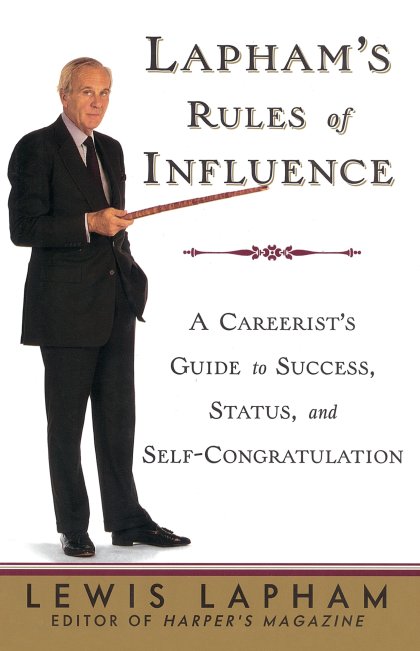
Drawing upon a lifetime of experience among the cogno-scenti, Mr. Lapham breaks rank and reveals the unspoken secrets of getting ahead: what to say, how to dress, when to lie, whom to befriend, where to be seen, and why it is absolutely essential to wear clean shoes. ("The first impression is also the last impression. You don't wish to be remembered as the stain on the rug.")
Anyone interested in self-advancement will be transformed by Lapham's Rules of Influence, which offers proven nuggets of wisdom. For example, when trying to impress the boss, remember: "Flattery cannot be too often or too recklessly applied. Think of it as suntan lotion or moisturizing cream."
Written with stinging wit and tongue planted firmly in cheek, Lapham's Rules of Influence is a brilliant critique of class and manners in America, packed with the kind of irreverent observation that only Lewis Lapham can provide.
Seek out the acquaintance of people richer and more important than yourself, and never take an interest in people who cannot do you any favors.
Rumor tinged with malice is the most precious form of gossip. When you are invited to spend a weekend with important journalists or movie stars, it is considered polite to bring four items of unpublished slander in lieu of a house present or a bottle of wine.
Make unsparing use of clichés. The empty word is the correct word. Contrary to the opinion of snobbish New York intellectuals, the placid murmur of cliché is always preferable to the expression of strong feeling, which is an embarrassment.
A truly fashionable dinner party ends at the moment when all the guests have arrived and everybody has been seen or not seen. Once attendance has been taken, the rest of the evening is superfluous.
A good meeting is one at which nothing happens. Sit erect, second all the motions, remember everybody's name.
STANDARD, PRIMARY, DM AND VARIANT COVERS
Standard and Primary covers are widely available through general retailers. They often have higher print runs and can be cheaper, especially during sales.
In contrast, Direct Market (DM) and variant covers are primarily sold in comic shops. DM editions tend to have more limited availability and may be more valuable to collectors.
The main differences lie in artwork style, availability, price, and collector appeal. Ultimately, the choice between standard and variant covers depends on personal preference, budget, and individual collecting goals.
PRODUCT TYPES
Comic book enthusiasts have various formats to choose from when collecting their favorite stories.
Here's a brief overview of the main types:
Omnibus
- Large, hardcover collections
- Usually contain complete runs or extensive story arcs
- Typically 800-1000+ pages
- Higher price point, often €100-€150
Oversized Hardcover (OHC)
- Similar dimensions to omnibus, but thinner
- Collect shorter runs or story arcs
- Usually 300-600 pages
- Priced between €30-€50
Hardcover (HC)
- Standard-sized hardcover books
- Collect 6-12 issues typically
- Similar dimensions to single issues, but with a hard cover
- Priced around €25-€35
Trade Paperback (TP)
- Softcover collections
- Standard comic book size
- Usually collect 4-6 issues
- Most affordable option, typically €15-€25
Other Formats
- Absolute Editions: Oversized, deluxe hardcovers (mainly DC Comics)
- Compendiums: Massive paperback collections
- Graphic Novels (OGN/GN): Original stories not previously released as single issues
The choice between these formats often depends on personal preference, budget, and collecting goals. Omnibus and OHC editions offer larger artwork and more content but at a higher price, while TPs provide a more affordable way to collect complete story arcs