

Clarkson Potter/Ten Speed
Last Call
Last Call
Couldn't load pickup availability
Collapsible content
ABOUT
JAMES BEARD AWARD FINALIST • WINNER OF THE TALES OF THE COCKTAIL SPIRITED AWARD® • NAMED ONE OF THE BEST COOKBOOKS OF THE YEAR BY CHICAGO TRIBUNE
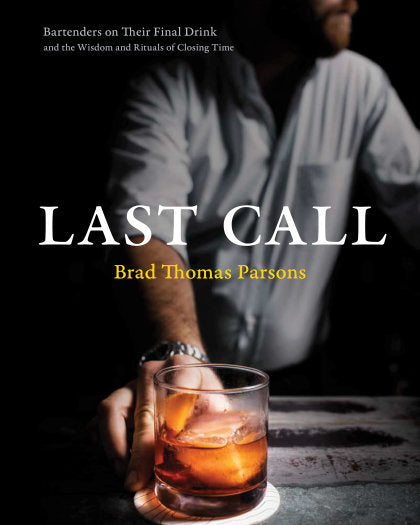
Everyone knows the parlor game question asked of every chef and food personality in countless interviews: What is the last meal you'd want to eat before you die? But what does it look like when you pose the question to bartenders? In Last Call, James Beard Award-winning author Brad Thomas Parsons gathers the intriguing responses from a diverse range of bartenders around the country, including Guido Martelli at the Palizzi Social Club in Philadelphia (he chooses an extra-dry Martini), Joseph Stinchcomb at Saint Leo in Oxford, Mississippi (he picks the Last Word, a pre-Prohibition-era cocktail that's now a cult favorite), and Natasha David at Nitecap in New York City (she would be sipping an extra-salty Margarita). The resulting interviews and essays reveal a personal portrait of some of the country's top bartenders and their favorite drinks, while over 40 cocktail recipes and stunning photography make this a keepsake for barflies and cocktail enthusiasts of all stripes.
Praise for Last Call
“[Parsons] captures the people and places through stunning photographs and prose. Like a perfectly balanced cocktail, it is equal parts cocktail recipes, travelogue and mixtape.”—The Atlanta Journal-Constitution
“Measure equal parts travelogue, tell-all, discography, and cocktail companion—in service of an obituary of all patrons—and you have Last Call; Brad Thomas Parsons’s best book yet. Through soulful photos and gritty interviews, he and photographer Ed Anderson capture the rawness, vulnerability, and ecstasy of the metamorphosis between the end of a guest’s night and the beginning of a bartender’s.”—Jim Meehan, author of Meehan’s Bartender Manual and The PDT Cocktail Book
“This book is a delight. Last Call shows us the sense of community evoked by bartenders across the country, whose wisdom and tenderness are captured here both in words and beautiful photographs. It made me—an erstwhile bartender and faithful customer—happy to remember that we all have nights when we unexpectedly hear the words ‘last call,’ and that noble and fascinating bartenders are out there waiting to share it with us.”—Alan Cumming
STANDARD, PRIMARY, DM AND VARIANT COVERS
Standard and Primary covers are widely available through general retailers. They often have higher print runs and can be cheaper, especially during sales.
In contrast, Direct Market (DM) and variant covers are primarily sold in comic shops. DM editions tend to have more limited availability and may be more valuable to collectors.
The main differences lie in artwork style, availability, price, and collector appeal. Ultimately, the choice between standard and variant covers depends on personal preference, budget, and individual collecting goals.
PRODUCT TYPES
Comic book enthusiasts have various formats to choose from when collecting their favorite stories.
Here's a brief overview of the main types:
Omnibus
- Large, hardcover collections
- Usually contain complete runs or extensive story arcs
- Typically 800-1000+ pages
- Higher price point, often €100-€150
Oversized Hardcover (OHC)
- Similar dimensions to omnibus, but thinner
- Collect shorter runs or story arcs
- Usually 300-600 pages
- Priced between €30-€50
Hardcover (HC)
- Standard-sized hardcover books
- Collect 6-12 issues typically
- Similar dimensions to single issues, but with a hard cover
- Priced around €25-€35
Trade Paperback (TP)
- Softcover collections
- Standard comic book size
- Usually collect 4-6 issues
- Most affordable option, typically €15-€25
Other Formats
- Absolute Editions: Oversized, deluxe hardcovers (mainly DC Comics)
- Compendiums: Massive paperback collections
- Graphic Novels (OGN/GN): Original stories not previously released as single issues
The choice between these formats often depends on personal preference, budget, and collecting goals. Omnibus and OHC editions offer larger artwork and more content but at a higher price, while TPs provide a more affordable way to collect complete story arcs