

Random House Publishing Group
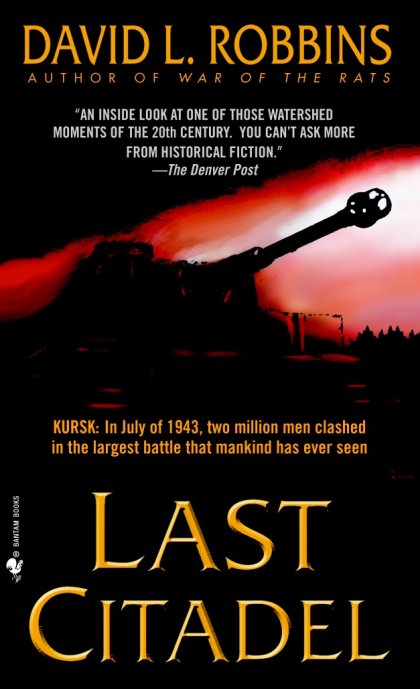
Last Citadel
Last Citadel
Couldn't load pickup availability
Collapsible content
ABOUT
Another fighting for survival.
Two armies locked in a bloody cataclysm that will decide history. . .
David L. Robbins has won widespread acclaim for his powerful and splendidly researched novels of World War II. Now he casts his brilliant vision on one of the most terrifying--and most crucial--battles of the war: the Battle of Kursk, Hitler’s desperate gamble to defeat Russia, in the final German offensive on the eastern front.
Last Citadel
Spring 1943. In the west, Germany strengthens its choke hold on France. To the south, an Allied invasion looms imminent. But the greatest threat to Hitler’s dream of a Thousand Year Reich lies east, where his forces are pitted in a death match with a Russian enemy willing to pay any price to defend the motherland. Hitler rolls the dice, hurling his best SS forces and his fearsome new weapon, the Mark VI Tiger tank, in a last-ditch summer offensive, code-named Citadel.
The Red Army around Kursk is a sprawling array of infantry, armor, fighter planes, and bombers. Among them is an intrepid group of women flying antiquated biplanes; they swoop over the Germans in the dark, earning their nickname, “Night Witches.” On the ground, Private Dimitri Berko gallops his tank, the Red Army’s lithe little T-34, like a Cossack steed. In the turret above Dimitri rides his son, Valya, a Communist sergeant who issues his father orders while the war widens the gulf between them. In the skies, Dimitri’s daughter, Katya, flies with the Night Witches, until she joins a ferocious band of partisans in the forests around Kursk. Like Russia itself, the Berko family is suffering the fury and devastation of history’s most titanic tank battle while fighting to preserve what is sacred–their land, their lives, and each other–as Hitler flings against them his most potent armed force.
Inexorable and devastating, a company of Mark VI Tiger tanks is commanded by one extraordinary SS officer, a Spaniard known as la Daga, the Dagger. He’d suffered a terrible wound at the hands of the Russians: now he has returned with a cold fury to exact his revenge. And above it all, one quiet man makes his own plan to bring Citadel crashing down and reshape the fate of the world.
A remarkable story of men and arms, loyalty and betrayal, Last Citadel propels us into the claustrophobic confines of a tank in combat, into the tension of guerrilla tactics, and across the smoking charnel of one of history’s greatest battlefields. Panoramic, authentic, and unforgettable, it reverberates long after the last cannon sounds.
STANDARD, PRIMARY, DM AND VARIANT COVERS
Standard and Primary covers are widely available through general retailers. They often have higher print runs and can be cheaper, especially during sales.
In contrast, Direct Market (DM) and variant covers are primarily sold in comic shops. DM editions tend to have more limited availability and may be more valuable to collectors.
The main differences lie in artwork style, availability, price, and collector appeal. Ultimately, the choice between standard and variant covers depends on personal preference, budget, and individual collecting goals.
PRODUCT TYPES
Comic book enthusiasts have various formats to choose from when collecting their favorite stories.
Here's a brief overview of the main types:
Omnibus
- Large, hardcover collections
- Usually contain complete runs or extensive story arcs
- Typically 800-1000+ pages
- Higher price point, often €100-€150
Oversized Hardcover (OHC)
- Similar dimensions to omnibus, but thinner
- Collect shorter runs or story arcs
- Usually 300-600 pages
- Priced between €30-€50
Hardcover (HC)
- Standard-sized hardcover books
- Collect 6-12 issues typically
- Similar dimensions to single issues, but with a hard cover
- Priced around €25-€35
Trade Paperback (TP)
- Softcover collections
- Standard comic book size
- Usually collect 4-6 issues
- Most affordable option, typically €15-€25
Other Formats
- Absolute Editions: Oversized, deluxe hardcovers (mainly DC Comics)
- Compendiums: Massive paperback collections
- Graphic Novels (OGN/GN): Original stories not previously released as single issues
The choice between these formats often depends on personal preference, budget, and collecting goals. Omnibus and OHC editions offer larger artwork and more content but at a higher price, while TPs provide a more affordable way to collect complete story arcs