

Crown
Late Bloomers
Late Bloomers
Couldn't load pickup availability
Collapsible content
ABOUT
“What Yogi Berra observed about a baseball game—it ain't over till it's over—is true about life, and [Late Bloomers] is the ultimate proof of this. . . . It’s a keeper.”—Forbes
We live in a society where kids and parents are obsessed with early achievement, from getting perfect scores on SATs to getting into Ivy League colleges to landing an amazing job at Google or Facebook—or even better, creating a start-up with the potential to be the next Google, Facebook or Uber. We see coders and entrepreneurs become millionaires or billionaires before age thirty, and feel we are failing if we are not one of them.
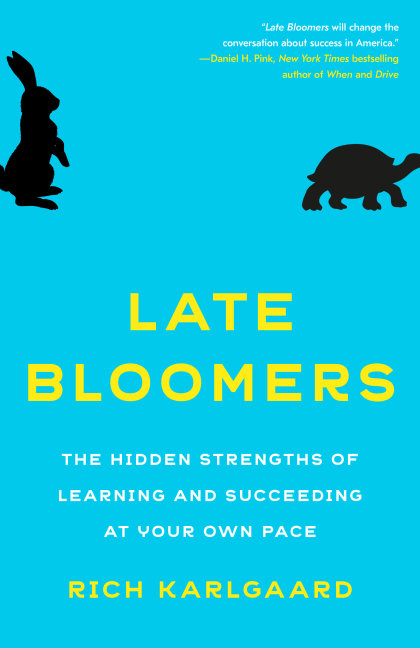
Late bloomers, on the other hand, are under-valued—in popular culture, by educators and employers, and even unwittingly by parents. Yet the fact is, a lot of us—most of us—do not explode out of the gates in life. We have to discover our passions and talents and gifts. That was true for author Rich Karlgaard, who had a mediocre academic career at Stanford (which he got into by a fluke) and, after graduating, worked as a dishwasher and night watchman before finding the inner motivation and drive that ultimately led him to start up a high-tech magazine in Silicon Valley, and eventually to become the publisher of Forbes magazine.
There is a scientific explanation for why so many of us bloom later in life. The executive function of our brains doesn’t mature until age twenty-five, and later for some. In fact, our brain’s capabilities peak at different ages. We actually experience multiple periods of blooming in our lives. Moreover, late bloomers enjoy hidden strengths because they take their time to discover their way in life—strengths coveted by many employers and partners—including curiosity, insight, compassion, resilience, and wisdom.
Based on years of research, personal experience, interviews with neuroscientists, psychologists, and countless people at different stages of their careers, Late Bloomers reveals how and when we achieve our full potential.
Praise for Late Bloomers
“The underlying message that we should ‘consider a kinder clock for human development’ is a compelling one.”—Financial Times
“Late Bloomers spoke to me deeply as a parent of two millennials and as a coach to many new college grads (the children of my friends and associates). It’s a bracing tonic for the anxiety they are swimming through, with a facts-based approach to help us all calm down.”—Robin Wolaner, founder of Parenting magazine
STANDARD, PRIMARY, DM AND VARIANT COVERS
Standard and Primary covers are widely available through general retailers. They often have higher print runs and can be cheaper, especially during sales.
In contrast, Direct Market (DM) and variant covers are primarily sold in comic shops. DM editions tend to have more limited availability and may be more valuable to collectors.
The main differences lie in artwork style, availability, price, and collector appeal. Ultimately, the choice between standard and variant covers depends on personal preference, budget, and individual collecting goals.
PRODUCT TYPES
Comic book enthusiasts have various formats to choose from when collecting their favorite stories.
Here's a brief overview of the main types:
Omnibus
- Large, hardcover collections
- Usually contain complete runs or extensive story arcs
- Typically 800-1000+ pages
- Higher price point, often €100-€150
Oversized Hardcover (OHC)
- Similar dimensions to omnibus, but thinner
- Collect shorter runs or story arcs
- Usually 300-600 pages
- Priced between €30-€50
Hardcover (HC)
- Standard-sized hardcover books
- Collect 6-12 issues typically
- Similar dimensions to single issues, but with a hard cover
- Priced around €25-€35
Trade Paperback (TP)
- Softcover collections
- Standard comic book size
- Usually collect 4-6 issues
- Most affordable option, typically €15-€25
Other Formats
- Absolute Editions: Oversized, deluxe hardcovers (mainly DC Comics)
- Compendiums: Massive paperback collections
- Graphic Novels (OGN/GN): Original stories not previously released as single issues
The choice between these formats often depends on personal preference, budget, and collecting goals. Omnibus and OHC editions offer larger artwork and more content but at a higher price, while TPs provide a more affordable way to collect complete story arcs