

Penguin Publishing Group
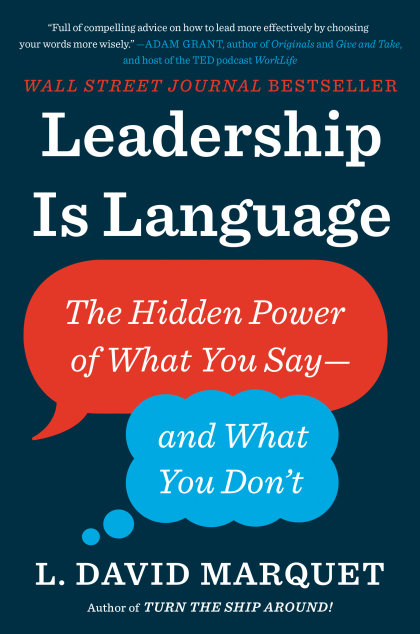
Leadership Is Language
Leadership Is Language
Couldn't load pickup availability
Collapsible content
ABOUT
From the acclaimed author of Turn the Ship Around!, former US Navy Captain David Marquet, comes a radical new playbook for empowering your team to make better decisions and take greater ownership.
As a leader in today's networked, information-dense business climate, you don't have full visibility into your organization or the ground reality of your operating environment. In order to harness the eyes, ears, and minds of your people, you need to foster a climate of collaborative experimentation that encourages people to speak up when they notice problems and work together to identify and test solutions.
In Leadership is Language, you'll learn how choosing your words can dramatically improve decision-making and execution on your team. Marquet outlines six plays for all leaders, anchored in how you use language:
• Control the clock, don't obey the clock: Pre-plan decision points and give your people the tools they need to hit pause on a plan of action if they notice something wrong.
• Collaborate, don't coerce: As the leader, you should be the last one to offer your opinion. Rather than locking your team into binary responses ("Is this a good plan?"), allow them to answer on a scale ("How confident are you about this plan?")
• Commit, don't comply: Rather than expect your team to comply with specific directions, explain your overall goals, and get their commitment to achieving it one piece at a time.
• Complete, not continue: If every day feels like a repetition of the last, you're doing something wrong. Articulate concrete plans with a start and end date to align your team.
• Improve, don't prove: Ask your people to improve on plans and processes, rather than prove that they can meet fixed goals or deadlines. You'll face fewer cut corners and better long-term results.
• Connect, don't conform: Flatten hierarchies in your organization and connect with your people to encourage them to contribute to decision-making.
In his last book, Turn the Ship Around!, Marquet told the incredible story of abandoning command-and-control leadership on his submarine and empowering his crew to turn the worst performing submarine to the best performer in the fleet. Now, with Leadership is Language he gives businesspeople the tools they need to achieve such transformational leadership in their organizations.
STANDARD, PRIMARY, DM AND VARIANT COVERS
Standard and Primary covers are widely available through general retailers. They often have higher print runs and can be cheaper, especially during sales.
In contrast, Direct Market (DM) and variant covers are primarily sold in comic shops. DM editions tend to have more limited availability and may be more valuable to collectors.
The main differences lie in artwork style, availability, price, and collector appeal. Ultimately, the choice between standard and variant covers depends on personal preference, budget, and individual collecting goals.
PRODUCT TYPES
Comic book enthusiasts have various formats to choose from when collecting their favorite stories.
Here's a brief overview of the main types:
Omnibus
- Large, hardcover collections
- Usually contain complete runs or extensive story arcs
- Typically 800-1000+ pages
- Higher price point, often €100-€150
Oversized Hardcover (OHC)
- Similar dimensions to omnibus, but thinner
- Collect shorter runs or story arcs
- Usually 300-600 pages
- Priced between €30-€50
Hardcover (HC)
- Standard-sized hardcover books
- Collect 6-12 issues typically
- Similar dimensions to single issues, but with a hard cover
- Priced around €25-€35
Trade Paperback (TP)
- Softcover collections
- Standard comic book size
- Usually collect 4-6 issues
- Most affordable option, typically €15-€25
Other Formats
- Absolute Editions: Oversized, deluxe hardcovers (mainly DC Comics)
- Compendiums: Massive paperback collections
- Graphic Novels (OGN/GN): Original stories not previously released as single issues
The choice between these formats often depends on personal preference, budget, and collecting goals. Omnibus and OHC editions offer larger artwork and more content but at a higher price, while TPs provide a more affordable way to collect complete story arcs