

Random House Publishing Group
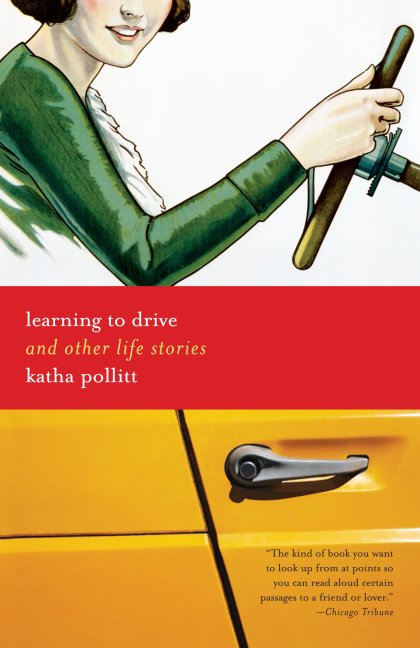
Learning to Drive
Learning to Drive
Couldn't load pickup availability
Collapsible content
ABOUT
Celebrated for her award-winning political columns, criticism, and poetry, Katha Pollitt now shows us another side of her talent. Learning to Drive is a surprising, revealing, and entertaining collection of essays drawn from the author’s own life.
With deep feeling and sharp insight, Pollitt writes about the death of her father; the sad but noble final days of a leftist study group of which she was a member; and the betrayal and heartbreak inflicted by a man who seriously deceived her. (Her infinitely patient, gentle driving instructor points out her weakness—“Observation, Katha, observation!”) She also offers a candid view of her preoccupation with her ex-lover’s haunting presence on the Internet, and her search there for a secret link that might provide a revelation about him that will Explain Everything.
Other topics include the differences between women and men—“More than half the male members of the Donner party died of cold and starvation, but three quarters of the females survived, saved by that extra layer of fat we spend our lives trying to get rid of”—and the practical implications of political theory: “What if socialism—all that warmhearted folderol about community and solidarity and sharing was just an elaborate con job, a way for men to avoid supporting their kids?”
Learning to Drive demonstrates that while Katha Pollitt is undeniably one of our era’s most profound observers of culture, society, and politics, she is just as impressively a wise, graceful, and honest observer of her own and others’ human nature.
Praise for Learning to Drive
“The kind of book you want to look up from at points so you can read aloud certain passages to a friend or lover.”—Chicago Tribune
“A powerful personal narrative . . . full of insight and charm . . . Pollitt is her own Jane Austen character . . . haughty and modest, moral and irresponsible, sensible and, happily for us, lost in sensibility.”—The New York Review of Books
“With . . . bracing self-honesty, Pollitt takes us through the maddening swirl of contradictions at the heart of being fifty-something: the sense of slowing down, of urgency, of wisdom, of ignorance, of strength, of helplessness, of breakdown, of renewal.”—The Seattle Times
“Essays of breathtaking candor and razor-sharp humor . . . [Pollitt] has outdone herself. . . . [Her] observations are acute and her confessions tonic. Forget face-lifts; Pollitt’s essays elevate the spirit.”—Booklist (starred review)
STANDARD, PRIMARY, DM AND VARIANT COVERS
Standard and Primary covers are widely available through general retailers. They often have higher print runs and can be cheaper, especially during sales.
In contrast, Direct Market (DM) and variant covers are primarily sold in comic shops. DM editions tend to have more limited availability and may be more valuable to collectors.
The main differences lie in artwork style, availability, price, and collector appeal. Ultimately, the choice between standard and variant covers depends on personal preference, budget, and individual collecting goals.
PRODUCT TYPES
Comic book enthusiasts have various formats to choose from when collecting their favorite stories.
Here's a brief overview of the main types:
Omnibus
- Large, hardcover collections
- Usually contain complete runs or extensive story arcs
- Typically 800-1000+ pages
- Higher price point, often €100-€150
Oversized Hardcover (OHC)
- Similar dimensions to omnibus, but thinner
- Collect shorter runs or story arcs
- Usually 300-600 pages
- Priced between €30-€50
Hardcover (HC)
- Standard-sized hardcover books
- Collect 6-12 issues typically
- Similar dimensions to single issues, but with a hard cover
- Priced around €25-€35
Trade Paperback (TP)
- Softcover collections
- Standard comic book size
- Usually collect 4-6 issues
- Most affordable option, typically €15-€25
Other Formats
- Absolute Editions: Oversized, deluxe hardcovers (mainly DC Comics)
- Compendiums: Massive paperback collections
- Graphic Novels (OGN/GN): Original stories not previously released as single issues
The choice between these formats often depends on personal preference, budget, and collecting goals. Omnibus and OHC editions offer larger artwork and more content but at a higher price, while TPs provide a more affordable way to collect complete story arcs