

Catapult
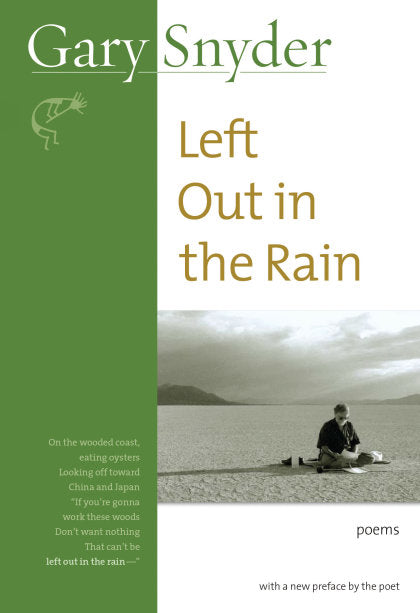
Left Out in the Rain
Left Out in the Rain
Couldn't load pickup availability
Collapsible content
ABOUT
“A fascinating case study and verse autobiography of a man who long ago staked his claim as one of America’s finest poets.” —Boston Herald
When Gary Snyder was in his twenties working as a forester and logger, one of the old loggers told him, “If you’re gonna work these woods, don’t want nothing that can’t be left out in the rain.”
Borrowing the phrase, Left Out in the Rain charts the journeys of the poet from 1947 to 1985. From the mountains and shores of the Pacific Northwest to the city streets of San Francisco, New York, and Kyoto, Snyder’s reflections are as much about the human experience as they are about the environment that encompasses it.
Sensual, sardonic, meditative, epigrammatic, formalist—whatever the subject, tone, or structure, these poems all bear the indelible stamp of a master. A villanelle for Finnish folklore, riffs on the neo–formalist poems trendy in the 1950s, a sestina on the philosophical dilemmas of anthropology and linguistics, a transformation of the third century BC Daoist essay “Discourse on Swords” into a satire on contemporary warlike administrations and governments—the experiments in this collection place Snyder among the most diverse of contemporary poets.
Left Out in the Rain means to include items carefully chosen to outlast the elements and remain useful for years. In his new preface to this edition, Snyder notes, “This complicated gathering of many poems, tight and loose together is like an understory ecosystem of the Old Growth. It needs rain.”
On the wooded coast,
eating oysters
Looking off toward
China and Japan
“If you’re gonna
work these woods
Don’t want nothing
That can’t be
left out in the rain—”
STANDARD, PRIMARY, DM AND VARIANT COVERS
Standard and Primary covers are widely available through general retailers. They often have higher print runs and can be cheaper, especially during sales.
In contrast, Direct Market (DM) and variant covers are primarily sold in comic shops. DM editions tend to have more limited availability and may be more valuable to collectors.
The main differences lie in artwork style, availability, price, and collector appeal. Ultimately, the choice between standard and variant covers depends on personal preference, budget, and individual collecting goals.
PRODUCT TYPES
Comic book enthusiasts have various formats to choose from when collecting their favorite stories.
Here's a brief overview of the main types:
Omnibus
- Large, hardcover collections
- Usually contain complete runs or extensive story arcs
- Typically 800-1000+ pages
- Higher price point, often €100-€150
Oversized Hardcover (OHC)
- Similar dimensions to omnibus, but thinner
- Collect shorter runs or story arcs
- Usually 300-600 pages
- Priced between €30-€50
Hardcover (HC)
- Standard-sized hardcover books
- Collect 6-12 issues typically
- Similar dimensions to single issues, but with a hard cover
- Priced around €25-€35
Trade Paperback (TP)
- Softcover collections
- Standard comic book size
- Usually collect 4-6 issues
- Most affordable option, typically €15-€25
Other Formats
- Absolute Editions: Oversized, deluxe hardcovers (mainly DC Comics)
- Compendiums: Massive paperback collections
- Graphic Novels (OGN/GN): Original stories not previously released as single issues
The choice between these formats often depends on personal preference, budget, and collecting goals. Omnibus and OHC editions offer larger artwork and more content but at a higher price, while TPs provide a more affordable way to collect complete story arcs