

Crown
Lights Out
Lights Out
Couldn't load pickup availability
Collapsible content
ABOUT
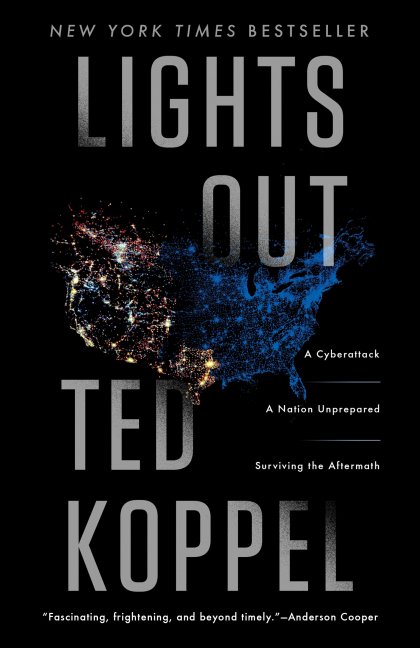
“Fascinating, frightening, and beyond timely.”—Anderson Cooper
Imagine a blackout lasting not days, but weeks or months. Tens of millions of people over several states are affected. For those without access to a generator, there is no running water, no sewage, no refrigeration or light. Food and medical supplies are dwindling. Devices we rely on have gone dark. Banks no longer function, looting is widespread, and law and order are being tested as never before.
It isn’t just a scenario. A well-designed attack on just one of the nation’s three electric power grids could cripple much of our infrastructure—and in the age of cyberwarfare, a laptop has become the only necessary weapon. Several nations hostile to the United States could launch such an assault at any time. In fact, as a former chief scientist of the NSA reveals, China and Russia have already penetrated the grid. And a cybersecurity advisor to President Obama believes that independent actors—from “hacktivists” to terrorists—have the capability as well. “It’s not a question of if,” says Centcom Commander General Lloyd Austin, “it’s a question of when.”
And yet, as Koppel makes clear, the federal government, while well prepared for natural disasters, has no plan for the aftermath of an attack on the power grid. The current Secretary of Homeland Security suggests keeping a battery-powered radio.
In the absence of a government plan, some individuals and communities have taken matters into their own hands. Among the nation’s estimated three million “preppers,” we meet one whose doomsday retreat includes a newly excavated three-acre lake, stocked with fish, and a Wyoming homesteader so self-sufficient that he crafted the thousands of adobe bricks in his house by hand. We also see the unrivaled disaster preparedness of the Mormon church, with its enormous storehouses, high-tech dairies, orchards, and proprietary trucking company—the fruits of a long tradition of anticipating the worst. But how, Koppel asks, will ordinary civilians survive?
With urgency and authority, one of our most renowned journalists examines a threat unique to our time and evaluates potential ways to prepare for a catastrophe that is all but inevitable.
STANDARD, PRIMARY, DM AND VARIANT COVERS
Standard and Primary covers are widely available through general retailers. They often have higher print runs and can be cheaper, especially during sales.
In contrast, Direct Market (DM) and variant covers are primarily sold in comic shops. DM editions tend to have more limited availability and may be more valuable to collectors.
The main differences lie in artwork style, availability, price, and collector appeal. Ultimately, the choice between standard and variant covers depends on personal preference, budget, and individual collecting goals.
PRODUCT TYPES
Comic book enthusiasts have various formats to choose from when collecting their favorite stories.
Here's a brief overview of the main types:
Omnibus
- Large, hardcover collections
- Usually contain complete runs or extensive story arcs
- Typically 800-1000+ pages
- Higher price point, often €100-€150
Oversized Hardcover (OHC)
- Similar dimensions to omnibus, but thinner
- Collect shorter runs or story arcs
- Usually 300-600 pages
- Priced between €30-€50
Hardcover (HC)
- Standard-sized hardcover books
- Collect 6-12 issues typically
- Similar dimensions to single issues, but with a hard cover
- Priced around €25-€35
Trade Paperback (TP)
- Softcover collections
- Standard comic book size
- Usually collect 4-6 issues
- Most affordable option, typically €15-€25
Other Formats
- Absolute Editions: Oversized, deluxe hardcovers (mainly DC Comics)
- Compendiums: Massive paperback collections
- Graphic Novels (OGN/GN): Original stories not previously released as single issues
The choice between these formats often depends on personal preference, budget, and collecting goals. Omnibus and OHC editions offer larger artwork and more content but at a higher price, while TPs provide a more affordable way to collect complete story arcs