

Penguin Publishing Group
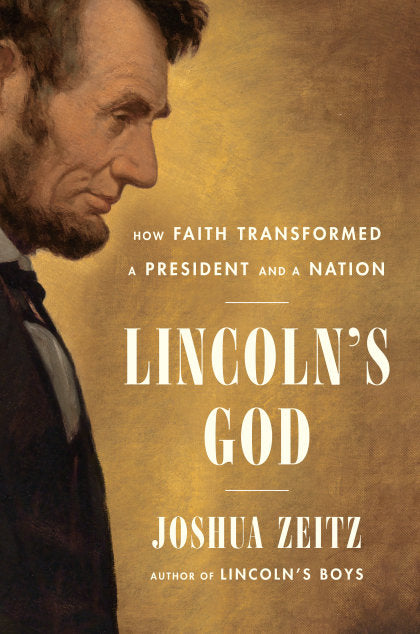
Lincoln's God
Lincoln's God
Couldn't load pickup availability
Collapsible content
ABOUT
Abraham Lincoln, unlike most of his political brethren, kept organized Christianity at arm’s length. He never joined a church and only sometimes attended Sunday services with his wife. But as he came to appreciate the growing political and military importance of the Christian community, and when death touched the Lincoln household in an awful, intimate way, the erstwhile skeptic effectively evolved into a believer and harnessed the power of evangelical Protestantism to rally the nation to arms. The war, he told Americans, was divine retribution for the sin of slavery.
This is the story of that transformation and the ways in which religion helped millions of Northerners interpret the carnage and political upheaval of the 1850s and 1860s. Rather than focus on battles and personalities, Joshua Zeitz probes ways in which war and spiritual convictions became intertwined. Characters include the famous—Harriet Beecher Stowe, Frederick Douglass, Henry Ward Beecher—as well as ordinary soldiers and their families whose evolving understanding of mortality, heaven, and mission motivated them to fight. Long underestimated in accounts of the Civil War, religion—specifically evangelical Christianity—played an instrumental role on the battlefield and home front, and in the corridors of government.
More than any president before him—or any president after, until George W. Bush—Lincoln harnessed popular religious enthusiasm to build broad-based support for a political party and a cause. A master politician who was sincere about his religion, Lincoln held beliefs that were unconventional—and widely misunderstood then, as now. After his death and the end of an unforgiving war, Americans needed to memorialize Lincoln as a Christian martyr. The truth was, of course, considerably more complicated, as this original book explores.
STANDARD, PRIMARY, DM AND VARIANT COVERS
Standard and Primary covers are widely available through general retailers. They often have higher print runs and can be cheaper, especially during sales.
In contrast, Direct Market (DM) and variant covers are primarily sold in comic shops. DM editions tend to have more limited availability and may be more valuable to collectors.
The main differences lie in artwork style, availability, price, and collector appeal. Ultimately, the choice between standard and variant covers depends on personal preference, budget, and individual collecting goals.
PRODUCT TYPES
Comic book enthusiasts have various formats to choose from when collecting their favorite stories.
Here's a brief overview of the main types:
Omnibus
- Large, hardcover collections
- Usually contain complete runs or extensive story arcs
- Typically 800-1000+ pages
- Higher price point, often €100-€150
Oversized Hardcover (OHC)
- Similar dimensions to omnibus, but thinner
- Collect shorter runs or story arcs
- Usually 300-600 pages
- Priced between €30-€50
Hardcover (HC)
- Standard-sized hardcover books
- Collect 6-12 issues typically
- Similar dimensions to single issues, but with a hard cover
- Priced around €25-€35
Trade Paperback (TP)
- Softcover collections
- Standard comic book size
- Usually collect 4-6 issues
- Most affordable option, typically €15-€25
Other Formats
- Absolute Editions: Oversized, deluxe hardcovers (mainly DC Comics)
- Compendiums: Massive paperback collections
- Graphic Novels (OGN/GN): Original stories not previously released as single issues
The choice between these formats often depends on personal preference, budget, and collecting goals. Omnibus and OHC editions offer larger artwork and more content but at a higher price, while TPs provide a more affordable way to collect complete story arcs