

Random House Publishing Group
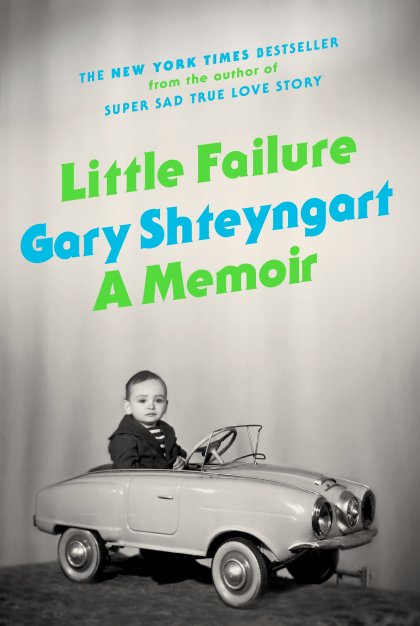
Little Failure
Little Failure
Couldn't load pickup availability
Collapsible content
ABOUT
NEW YORK TIMES BESTSELLER • NATIONAL BOOK CRITICS CIRCLE AWARD FINALIST
NAMED ONE OF THE TEN BEST BOOKS OF THE YEAR BY MICHIKO KAKUTANI, THE NEW YORK TIMES • NAMED ONE OF THE TEN BEST NONFICTION BOOKS OF THE YEAR BY TIME
NAMED ONE OF THE BEST BOOKS OF THE YEAR BY MORE THAN 45 PUBLICATIONS, INCLUDING
The New York Times Book Review • The Washington Post • NPR • The New Yorker • San Francisco Chronicle • The Economist • The Atlantic • Newsday • Salon • St. Louis Post-Dispatch • The Guardian • Esquire (UK) • GQ (UK)
After three acclaimed novels, Gary Shteyngart turns to memoir in a candid, witty, deeply poignant account of his life so far. Shteyngart shares his American immigrant experience, moving back and forth through time and memory with self-deprecating humor, moving insights, and literary bravado. The result is a resonant story of family and belonging that feels epic and intimate and distinctly his own.
Born Igor Shteyngart in Leningrad during the twilight of the Soviet Union, the curious, diminutive, asthmatic boy grew up with a persistent sense of yearning—for food, for acceptance, for words—desires that would follow him into adulthood. At five, Igor wrote his first novel, Lenin and His Magical Goose, and his grandmother paid him a slice of cheese for every page.
In the late 1970s, world events changed Igor’s life. Jimmy Carter and Leonid Brezhnev made a deal: exchange grain for the safe passage of Soviet Jews to America—a country Igor viewed as the enemy. Along the way, Igor became Gary so that he would suffer one or two fewer beatings from other kids. Coming to the United States from the Soviet Union was equivalent to stumbling off a monochromatic cliff and landing in a pool of pure Technicolor.
Shteyngart’s loving but mismatched parents dreamed that he would become a lawyer or at least a “conscientious toiler” on Wall Street, something their distracted son was simply not cut out to do. Fusing English and Russian, his mother created the term Failurchka—Little Failure—which she applied to her son. With love. Mostly.
As a result, Shteyngart operated on a theory that he would fail at everything he tried. At being a writer, at being a boyfriend, and, most important, at being a worthwhile human being.
Swinging between a Soviet home life and American aspirations, Shteyngart found himself living in two contradictory worlds, all the while wishing that he could find a real home in one. And somebody to love him. And somebody to lend him sixty-nine cents for a McDonald’s hamburger.
Provocative, hilarious, and inventive, Little Failure reveals a deeper vein of emotion in Gary Shteyngart’s prose. It is a memoir of an immigrant family coming to America, as told by a lifelong misfit who forged from his imagination an essential literary voice and, against all odds, a place in the world.
Praise for Little Failure
“Hilarious and moving . . . The army of readers who love Gary Shteyngart is about to get bigger.”—The New York Times Book Review
“A memoir for the ages . . . brilliant and unflinching.”—Mary Karr
“Dazzling . . . a rich, nuanced memoir . . . It’s an immigrant story, a coming-of-age story, a becoming-a-writer story, and a becoming-a-mensch story, and in all these ways it is, unambivalently, a success.”—Meg Wolitzer, NPR
“Literary gold . . . bruisingly funny.”—Vogue
“A giant success.”—Entertainment Weekly
STANDARD, PRIMARY, DM AND VARIANT COVERS
Standard and Primary covers are widely available through general retailers. They often have higher print runs and can be cheaper, especially during sales.
In contrast, Direct Market (DM) and variant covers are primarily sold in comic shops. DM editions tend to have more limited availability and may be more valuable to collectors.
The main differences lie in artwork style, availability, price, and collector appeal. Ultimately, the choice between standard and variant covers depends on personal preference, budget, and individual collecting goals.
PRODUCT TYPES
Comic book enthusiasts have various formats to choose from when collecting their favorite stories.
Here's a brief overview of the main types:
Omnibus
- Large, hardcover collections
- Usually contain complete runs or extensive story arcs
- Typically 800-1000+ pages
- Higher price point, often €100-€150
Oversized Hardcover (OHC)
- Similar dimensions to omnibus, but thinner
- Collect shorter runs or story arcs
- Usually 300-600 pages
- Priced between €30-€50
Hardcover (HC)
- Standard-sized hardcover books
- Collect 6-12 issues typically
- Similar dimensions to single issues, but with a hard cover
- Priced around €25-€35
Trade Paperback (TP)
- Softcover collections
- Standard comic book size
- Usually collect 4-6 issues
- Most affordable option, typically €15-€25
Other Formats
- Absolute Editions: Oversized, deluxe hardcovers (mainly DC Comics)
- Compendiums: Massive paperback collections
- Graphic Novels (OGN/GN): Original stories not previously released as single issues
The choice between these formats often depends on personal preference, budget, and collecting goals. Omnibus and OHC editions offer larger artwork and more content but at a higher price, while TPs provide a more affordable way to collect complete story arcs