

Library of America
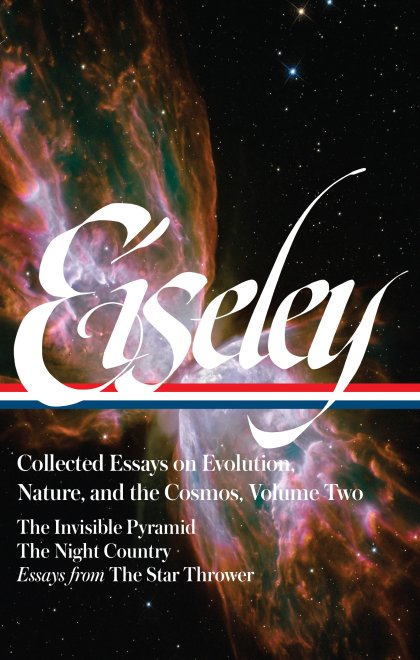
Loren Eiseley: Collected Essays on Evolution, Nature, and the Cosmos Vol. 2 (LOA#286)
Loren Eiseley: Collected Essays on Evolution, Nature, and the Cosmos Vol. 2 (LOA#286)
Couldn't load pickup availability
Collapsible content
ABOUT
This second volume begins with The Invisible Pyramid (1970), a book of meditations on the origins and possible futures of humankind set against the backdrop of the Apollo 11 landings. As Western civilization attains new heights of scientific awareness and technological skill, is it also blind to its own limits, doomed to destroy itself like the lost civilizations of the ancients or other “spore-bearers” in our evolutionary past? Eiseley makes an urgent, environmentalist plea in these essays: we must protect the planet from which we emerged against our unchecked power to overpopulate and pollute and consume it.
The essays in The Night Country (1971) look not to the stars but backward and inward: to the haunted spaces of Eiseley’s lonely Nebraska childhood and to those moments, often dark and unexpected, when chance observations disturb our ordinary understandings of the universe. The naturalist here seeks neither “salvation in facts” nor solace in wild places: encountering an old bone, or a nest of wasps, he recognizes what he calls “the ghostliness of myself,” his own mortality, and the paradoxes of the evolution of consciousness.
Shortly before his death, Eiseley made plans for what would be his last book, published posthumously as The Star Thrower (1978). Here are late essays on the life and legacy of Henry David Thoreau, the writer to whom he turned more often than any other; thoughts on the “two cultures” he sought to bring together throughout his career; and on the relations between hard science and “awe before the universe.” Of particular interest are two early stories discovered among his papers, “The Dance of the Frogs” and “The Fifth Planet.”
A companion volume gathers The Immense Journey (1957), The Firmament of Time (1960), The Unexpected Universe (1969), and a selection of Eiseley’s uncollected prose.
LIBRARY OF AMERICA is an independent nonprofit cultural organization founded in 1979 to preserve our nation’s literary heritage by publishing, and keeping permanently in print, America’s best and most significant writing. The Library of America series includes more than 300 volumes to date, authoritative editions that average 1,000 pages in length, feature cloth covers, sewn bindings, and ribbon markers, and are printed on premium acid-free paper that will last for centuries.
STANDARD, PRIMARY, DM AND VARIANT COVERS
Standard and Primary covers are widely available through general retailers. They often have higher print runs and can be cheaper, especially during sales.
In contrast, Direct Market (DM) and variant covers are primarily sold in comic shops. DM editions tend to have more limited availability and may be more valuable to collectors.
The main differences lie in artwork style, availability, price, and collector appeal. Ultimately, the choice between standard and variant covers depends on personal preference, budget, and individual collecting goals.
PRODUCT TYPES
Comic book enthusiasts have various formats to choose from when collecting their favorite stories.
Here's a brief overview of the main types:
Omnibus
- Large, hardcover collections
- Usually contain complete runs or extensive story arcs
- Typically 800-1000+ pages
- Higher price point, often €100-€150
Oversized Hardcover (OHC)
- Similar dimensions to omnibus, but thinner
- Collect shorter runs or story arcs
- Usually 300-600 pages
- Priced between €30-€50
Hardcover (HC)
- Standard-sized hardcover books
- Collect 6-12 issues typically
- Similar dimensions to single issues, but with a hard cover
- Priced around €25-€35
Trade Paperback (TP)
- Softcover collections
- Standard comic book size
- Usually collect 4-6 issues
- Most affordable option, typically €15-€25
Other Formats
- Absolute Editions: Oversized, deluxe hardcovers (mainly DC Comics)
- Compendiums: Massive paperback collections
- Graphic Novels (OGN/GN): Original stories not previously released as single issues
The choice between these formats often depends on personal preference, budget, and collecting goals. Omnibus and OHC editions offer larger artwork and more content but at a higher price, while TPs provide a more affordable way to collect complete story arcs