

Random House Publishing Group
Love You, Mean It
Love You, Mean It
Couldn't load pickup availability
Collapsible content
ABOUT
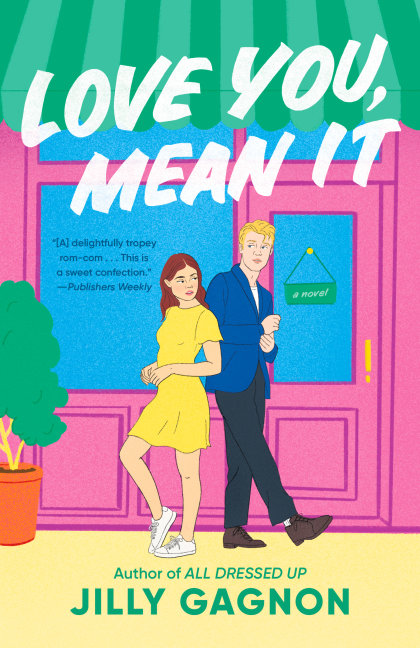
“[A] delightfully tropey rom-com . . . This is a sweet confection.”—Publishers Weekly
Ellie Greco wishes she weren’t stuck in Milborough. For a few brief, shining years, she escaped her hometown to pursue her dream career—designing beautiful, elaborate costumes for theater—until her father's death five years ago called her home to run the family's decades-old deli. Yes, she loves the place, but she’d always thought she was meant for more exciting things than stocking the right tinned fish. But when Ellie hears that a local landlord is planning to rent to Mangia, the glitzy gourmet food department store, the very existence of Greco’s Deli is suddenly in jeopardy.
She tries to plead her case to Theo Taylor, scion of the property management firm that is about to put her out of business, but their meeting goes from bad (it’s not her fault he’s infuriating) to worse (no one expects the ceiling to literally fall in).
With Theo out cold, Ellie panics and claims to be his fiancée . . . and almost passes out herself when amnesia means Theo seems to actually believe her. Soon, the effects of the head injury wear off, but Theo proposes that their “engagement” stick around. If they manage to convince enough people, they might both get what they want: an end to the Mangia deal. Ellie doesn’t trust him (after all, if Theo Taylor wants it, how can it be good for her?) but seeing no other option, she reluctantly agrees.
And miraculously, the fake engagement seems to be working—even Ted, Theo’s shrewd, cold father seems convinced—that is, until Sam, Theo’s ex-fiancée, reappears on the scene. Not only does she see through their ruse, but she proposes an arrangement of her own, forcing Ellie to decide between a blossoming friendship, her family legacy, and the burgeoning romance she frankly never asked for.
STANDARD, PRIMARY, DM AND VARIANT COVERS
Standard and Primary covers are widely available through general retailers. They often have higher print runs and can be cheaper, especially during sales.
In contrast, Direct Market (DM) and variant covers are primarily sold in comic shops. DM editions tend to have more limited availability and may be more valuable to collectors.
The main differences lie in artwork style, availability, price, and collector appeal. Ultimately, the choice between standard and variant covers depends on personal preference, budget, and individual collecting goals.
PRODUCT TYPES
Comic book enthusiasts have various formats to choose from when collecting their favorite stories.
Here's a brief overview of the main types:
Omnibus
- Large, hardcover collections
- Usually contain complete runs or extensive story arcs
- Typically 800-1000+ pages
- Higher price point, often €100-€150
Oversized Hardcover (OHC)
- Similar dimensions to omnibus, but thinner
- Collect shorter runs or story arcs
- Usually 300-600 pages
- Priced between €30-€50
Hardcover (HC)
- Standard-sized hardcover books
- Collect 6-12 issues typically
- Similar dimensions to single issues, but with a hard cover
- Priced around €25-€35
Trade Paperback (TP)
- Softcover collections
- Standard comic book size
- Usually collect 4-6 issues
- Most affordable option, typically €15-€25
Other Formats
- Absolute Editions: Oversized, deluxe hardcovers (mainly DC Comics)
- Compendiums: Massive paperback collections
- Graphic Novels (OGN/GN): Original stories not previously released as single issues
The choice between these formats often depends on personal preference, budget, and collecting goals. Omnibus and OHC editions offer larger artwork and more content but at a higher price, while TPs provide a more affordable way to collect complete story arcs