

Random House Publishing Group
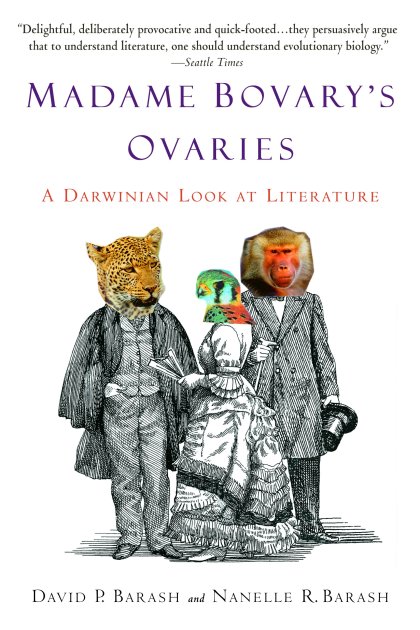
Madame Bovary's Ovaries
Madame Bovary's Ovaries
Couldn't load pickup availability
Collapsible content
ABOUT
How do gorillas illuminate the works of Shakespeare?
What do bloodsucking bats have to do with John Steinbeck?
Madame Bovary's Ovaries
A Darwinian Look at Literature
According to evolutionary psychologist David Barash and his daughter Nanelle, the answers lie in the most important word in biology: evolution. Just like every animal from mites to monkeys, our day-to-day behavior has been shaped by millions of years of natural selection. So it should be no surprise to learn that the natural forces that drive animals in general and Homo sapiens in particular are clearly visible in the creatures of literature, from Henry Fielding’s Tom Jones all the way to Helen Fielding’s Bridget Jones. Seen through the lens of evolutionary biology, the witty repartee of Jane Austen’s courting couples, Othello’s tragic rage, the griping of Holden Caulfield, and the scandalous indiscretions of Madame Bovary herself all make a fresh and exciting kind of sense.
The ways we fall in—and out—of love, stand by our friends, compete against our enemies, and squabble with our families have their roots in biological imperatives we share not only with other primates but with an amazing array of other creatures. The result is a new way to read, a novel approach to novels (and plays) that reveals how human nature underlies literature, from the great to the not-so-great.
Using the cutting-edge ideas of contemporary Darwinism, the authors show how the heroes and heroines of our favorite stories have been molded as much by evolution as by the genius of their creators, revealing a gallery of characters from Agamemnon to Alexander Portnoy, who have more in common with birds, fish, and other mammals than we could ever have imagined.
As engaging and informative as a good story, Madame Bovary’s Ovaries is both an accessible introduction to a fascinating area of science and a provocatively sideways look at our cherished literary heritage. Most of all, it shows in a delightfully enteraining way how science and literature shed light on each other.
STANDARD, PRIMARY, DM AND VARIANT COVERS
Standard and Primary covers are widely available through general retailers. They often have higher print runs and can be cheaper, especially during sales.
In contrast, Direct Market (DM) and variant covers are primarily sold in comic shops. DM editions tend to have more limited availability and may be more valuable to collectors.
The main differences lie in artwork style, availability, price, and collector appeal. Ultimately, the choice between standard and variant covers depends on personal preference, budget, and individual collecting goals.
PRODUCT TYPES
Comic book enthusiasts have various formats to choose from when collecting their favorite stories.
Here's a brief overview of the main types:
Omnibus
- Large, hardcover collections
- Usually contain complete runs or extensive story arcs
- Typically 800-1000+ pages
- Higher price point, often €100-€150
Oversized Hardcover (OHC)
- Similar dimensions to omnibus, but thinner
- Collect shorter runs or story arcs
- Usually 300-600 pages
- Priced between €30-€50
Hardcover (HC)
- Standard-sized hardcover books
- Collect 6-12 issues typically
- Similar dimensions to single issues, but with a hard cover
- Priced around €25-€35
Trade Paperback (TP)
- Softcover collections
- Standard comic book size
- Usually collect 4-6 issues
- Most affordable option, typically €15-€25
Other Formats
- Absolute Editions: Oversized, deluxe hardcovers (mainly DC Comics)
- Compendiums: Massive paperback collections
- Graphic Novels (OGN/GN): Original stories not previously released as single issues
The choice between these formats often depends on personal preference, budget, and collecting goals. Omnibus and OHC editions offer larger artwork and more content but at a higher price, while TPs provide a more affordable way to collect complete story arcs