

Library of America
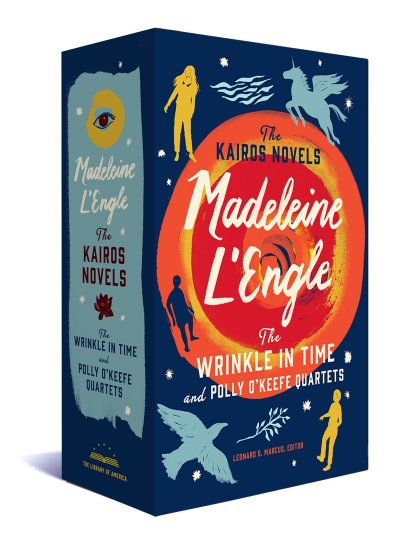
Madeleine L'Engle: The Kairos Novels: The Wrinkle in Time and Polly O'Keefe Quartets
Madeleine L'Engle: The Kairos Novels: The Wrinkle in Time and Polly O'Keefe Quartets
Couldn't load pickup availability
Collapsible content
ABOUT
Here, for the first time, in a newly-prepared authoritative text, Madeleine L'Engle's iconic classic A Wrinkle in Time, one of the most beloved and influential novels for young readers ever written, is presented with all seven of its sequels--what L'Engle called the Kairos (or "cosmic time") novels--in a deluxe two-volume boxed set, complete with never-before-seen deleted passages from A Wrinkle in Time. L'Engle's unforgettable heroine, Meg Murry, must confront her fears and self-doubt to rescue her scientist father, who has been experimenting with mysterious tesseracts capable of bending the very fabric of space and time. Helping her are her little brother Charles Wallace and her friend Calvin O'Keefe, and a trio of strange supernatural visitors called Mrs Whatsit, Mrs Who, and Mrs Which. But A Wrinkle in Time was only the beginning of the adventure.
In A Wind in the Door, Meg and Calvin descend into the microverse to save Charles Wallace from beings called Echthroi, who are trying to erase existence. In A Swiftly Tilting Planet, when a madman threatens nuclear war, Charles Wallace must save the future by traveling into the past. And in Many Waters, Meg's twin brothers are accidentally transported back to the time of Noah's ark. The final four books center on Calvin and Meg's daughter Polly. In The Arm of the Starfish, Polly disappears, and Calvin's research assistant is implicated in her kidnapping. In Dragons in the Waters, Polly and her brother Charles are on a ship sailing to Venezuela when they help solve a murder connected to a stolen portrait of Simon Bolivar. Polly receives an education in different kinds of love in A House Like a Lotus. And in An Acceptable Time, Polly is lured through a tesseract by a friend who may be hoping to sacrifice Polly in order to save himself.
LIBRARY OF AMERICA is an independent nonprofit cultural organization founded in 1979 to preserve our nation’s literary heritage by publishing, and keeping permanently in print, America’s best and most significant writing. The Library of America series includes more than 300 volumes to date, authoritative editions that average 1,000 pages in length, feature cloth covers, sewn bindings, and ribbon markers, and are printed on premium acid-free paper that will last for centuries.
STANDARD, PRIMARY, DM AND VARIANT COVERS
Standard and Primary covers are widely available through general retailers. They often have higher print runs and can be cheaper, especially during sales.
In contrast, Direct Market (DM) and variant covers are primarily sold in comic shops. DM editions tend to have more limited availability and may be more valuable to collectors.
The main differences lie in artwork style, availability, price, and collector appeal. Ultimately, the choice between standard and variant covers depends on personal preference, budget, and individual collecting goals.
PRODUCT TYPES
Comic book enthusiasts have various formats to choose from when collecting their favorite stories.
Here's a brief overview of the main types:
Omnibus
- Large, hardcover collections
- Usually contain complete runs or extensive story arcs
- Typically 800-1000+ pages
- Higher price point, often €100-€150
Oversized Hardcover (OHC)
- Similar dimensions to omnibus, but thinner
- Collect shorter runs or story arcs
- Usually 300-600 pages
- Priced between €30-€50
Hardcover (HC)
- Standard-sized hardcover books
- Collect 6-12 issues typically
- Similar dimensions to single issues, but with a hard cover
- Priced around €25-€35
Trade Paperback (TP)
- Softcover collections
- Standard comic book size
- Usually collect 4-6 issues
- Most affordable option, typically €15-€25
Other Formats
- Absolute Editions: Oversized, deluxe hardcovers (mainly DC Comics)
- Compendiums: Massive paperback collections
- Graphic Novels (OGN/GN): Original stories not previously released as single issues
The choice between these formats often depends on personal preference, budget, and collecting goals. Omnibus and OHC editions offer larger artwork and more content but at a higher price, while TPs provide a more affordable way to collect complete story arcs