

Berrett-Koehler Publishers
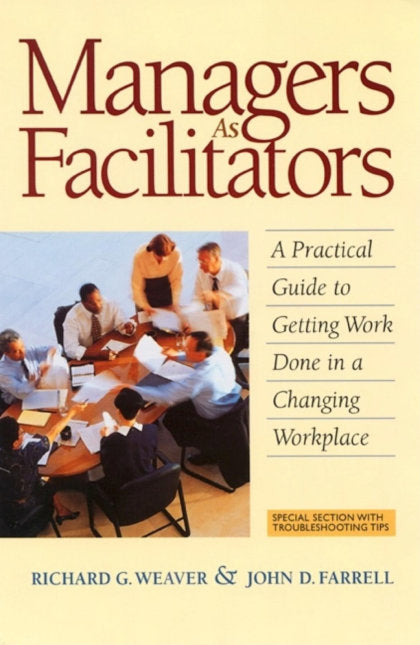
Managers As Facilitators
Managers As Facilitators
Couldn't load pickup availability
Collapsible content
ABOUT
Teaches managers the facilitation skills they need to help their organizations improve productivity
Includes real-life examples from manufacturing, telecommunications, health care, education, retail and other service businesses, and government and other non-profit organizations
Today's managers are confronted with increasing pressure to produce more with fewer resources. In this pressure-packed environment, managers are finding that the old "direct-and-control" model simply does not work. People need more freedom to make decisions, respond quickly to their customers, and work together more effectively. Successful managers have learned how to use the role of facilitator to help people exercise this freedom to produce the results needed by their organizations.
Managers As Facilitators presents a new, easy-to-understand model of facilitation that focuses on getting work done. It provides practical guidance for managers and leaders who need to be successful in this new role. Weaver and Farrell show managers how to use themselves in new ways, capitalize on group dynamics, and build effective work processes. They explain that to become a successful facilitator, one must recognize and use the four key elements of the facilitation model:
1. Task: Facilitators are clear about the work that groups must complete; task drives the actions of effective facilitators.
2. Self: Facilitators learn how to use themselves to help groups complete their tasks; facilitators do this by both using their own personal thoughts and feelings as a "barometer" for groups and modeling the types of behavior expected from others.
3. Group: Facilitators help groups understand the difference between normal interactions and those that are a problem; facilitators also help groups capitalize on conflict, rather than be disabled by it.
4. Process: Facilitators use three fundamental processes to help groups: planning, solving problems, and completing work; facilitators are skilled with a number of facilitation tools, using them to help groups run effective meetings, finish projects, etc.
Managers As Facilitators offers readers practical ways to manage change and organizational boundaries to achieve the results they want. The authors explain how individuals, groups, and organizations experience change and work with boundaries-and what facilitators do to help. The book's final chapter synthesizes all the material by presenting "Quick Fixes" to common problems.
STANDARD, PRIMARY, DM AND VARIANT COVERS
Standard and Primary covers are widely available through general retailers. They often have higher print runs and can be cheaper, especially during sales.
In contrast, Direct Market (DM) and variant covers are primarily sold in comic shops. DM editions tend to have more limited availability and may be more valuable to collectors.
The main differences lie in artwork style, availability, price, and collector appeal. Ultimately, the choice between standard and variant covers depends on personal preference, budget, and individual collecting goals.
PRODUCT TYPES
Comic book enthusiasts have various formats to choose from when collecting their favorite stories.
Here's a brief overview of the main types:
Omnibus
- Large, hardcover collections
- Usually contain complete runs or extensive story arcs
- Typically 800-1000+ pages
- Higher price point, often €100-€150
Oversized Hardcover (OHC)
- Similar dimensions to omnibus, but thinner
- Collect shorter runs or story arcs
- Usually 300-600 pages
- Priced between €30-€50
Hardcover (HC)
- Standard-sized hardcover books
- Collect 6-12 issues typically
- Similar dimensions to single issues, but with a hard cover
- Priced around €25-€35
Trade Paperback (TP)
- Softcover collections
- Standard comic book size
- Usually collect 4-6 issues
- Most affordable option, typically €15-€25
Other Formats
- Absolute Editions: Oversized, deluxe hardcovers (mainly DC Comics)
- Compendiums: Massive paperback collections
- Graphic Novels (OGN/GN): Original stories not previously released as single issues
The choice between these formats often depends on personal preference, budget, and collecting goals. Omnibus and OHC editions offer larger artwork and more content but at a higher price, while TPs provide a more affordable way to collect complete story arcs