

Library of America
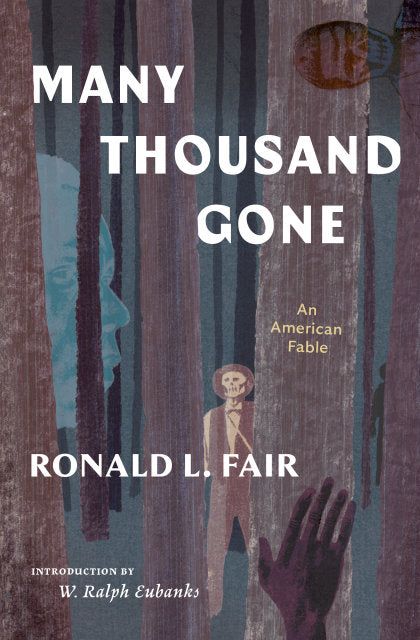
Many Thousand Gone: An American Fable
Many Thousand Gone: An American Fable
Couldn't load pickup availability
Collapsible content
ABOUT
From the Civil Rights Era comes an urgent allegory about the terror and tragedy of Jim Crow, with a new introduction by W. Ralph Eubanks
The premise of Ronald Fair’s short, parable-like novel, Many Thousand Gone: An American Fable (1965), is that in a rural corner of Mississippi—the fictional Jacobs County—slavery did not end in 1865 but continued uninterrupted into the 1960s through the brutal tactics of the local sheriff's office and the willing complicity of surrounding counties. Black outsiders are not allowed into Jacobs County while Black inhabitants attempting to escape are hunted down and killed. All the Black women in the county have been made sexually available to any white man for generations, resulting in the mixed blood of nearly all the enslaved population.
When the last all-Black child, “the Black Prince,” is born, he is secreted out of the county by his great-grandmother and a family friend, and eventually makes his way north to join his father. Years later, when the Black Prince becomes a celebrated writer in Chicago, his growing fame puts an unwanted spotlight on Jacobs County, emboldening the enslaved population, exposing the white supremacists’ false sense of superiority, and setting in motion a series of events that will change everything. Will the white population change with the times? Or will they willingly see the destruction of Jacobsville—the county’s principal town—before sharing power with the Black population?
An introduction by W. Ralph Eubanks explores Fair’s extended metaphor for Black life under Jim Crow and reflects on the power of literature to illuminate the past.
STANDARD, PRIMARY, DM AND VARIANT COVERS
Standard and Primary covers are widely available through general retailers. They often have higher print runs and can be cheaper, especially during sales.
In contrast, Direct Market (DM) and variant covers are primarily sold in comic shops. DM editions tend to have more limited availability and may be more valuable to collectors.
The main differences lie in artwork style, availability, price, and collector appeal. Ultimately, the choice between standard and variant covers depends on personal preference, budget, and individual collecting goals.
PRODUCT TYPES
Comic book enthusiasts have various formats to choose from when collecting their favorite stories.
Here's a brief overview of the main types:
Omnibus
- Large, hardcover collections
- Usually contain complete runs or extensive story arcs
- Typically 800-1000+ pages
- Higher price point, often €100-€150
Oversized Hardcover (OHC)
- Similar dimensions to omnibus, but thinner
- Collect shorter runs or story arcs
- Usually 300-600 pages
- Priced between €30-€50
Hardcover (HC)
- Standard-sized hardcover books
- Collect 6-12 issues typically
- Similar dimensions to single issues, but with a hard cover
- Priced around €25-€35
Trade Paperback (TP)
- Softcover collections
- Standard comic book size
- Usually collect 4-6 issues
- Most affordable option, typically €15-€25
Other Formats
- Absolute Editions: Oversized, deluxe hardcovers (mainly DC Comics)
- Compendiums: Massive paperback collections
- Graphic Novels (OGN/GN): Original stories not previously released as single issues
The choice between these formats often depends on personal preference, budget, and collecting goals. Omnibus and OHC editions offer larger artwork and more content but at a higher price, while TPs provide a more affordable way to collect complete story arcs