

Doubleday Canada
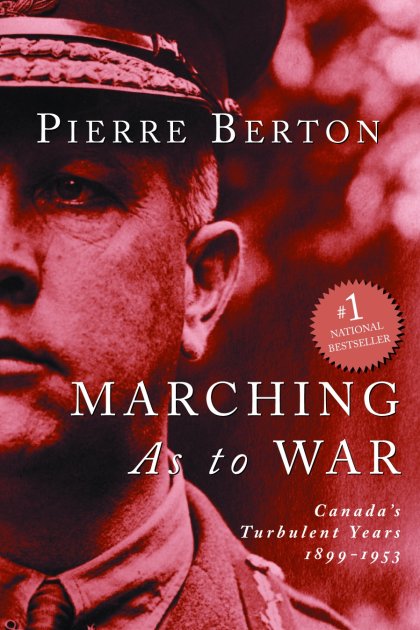
Marching as to War
Marching as to War
Couldn't load pickup availability
Collapsible content
ABOUT
Canada's twentieth century can be divided roughly into two halves. All the wars and all the unnecessary battles in which Canadian youth was squandered belong to the first — from the autumn of 1899 to the summer of 1953. From the mid-1950s on, Canada has concerned itself not with war but with peace.
The first war of the century, which took Canadian soldiers to South Africa, and the last, which sent them to Korea, bracket the bookends on the shelf of history. They have a good deal in common with, these two minor conflicts, whose chronicles pale when compared to the bloodbaths of the two world wars.
Canada's wartime days are long past, and for many, the scars of war have healed. Vimy has been manicured clean, its pockmarked slopes softened by a green mantle of Canadian pines. Dieppe has reverted to a resort town, its beaches long since washed free of Canadian blood. Nowadays, Canadians are proud of their role as Peacekeepers, from which they have gained a modicum of international acclaim the nation has always craved, with precious little blood wasted in the process.
In this monumental work, Pierre Berton brings Canadian history to life once again, relying on a host of sources, including newspaper accounts and first-hand reports, to tell the story of these four wars through the eyes of the privates in the trenches, the generals at the front, and the politicians and families back home. By profiling the interwar years, Berton traces how one war led to the next, and how the country was changed in the process. Illustrated with maps and line drawings, Marching as to War describes how the experience of war helped to bind Canada together as a nation and chronicles the transformation of Canada's dependence upon Great Britain and its slow emergence as an independent nation caught in a love-hate relationship with the United States.
STANDARD, PRIMARY, DM AND VARIANT COVERS
Standard and Primary covers are widely available through general retailers. They often have higher print runs and can be cheaper, especially during sales.
In contrast, Direct Market (DM) and variant covers are primarily sold in comic shops. DM editions tend to have more limited availability and may be more valuable to collectors.
The main differences lie in artwork style, availability, price, and collector appeal. Ultimately, the choice between standard and variant covers depends on personal preference, budget, and individual collecting goals.
PRODUCT TYPES
Comic book enthusiasts have various formats to choose from when collecting their favorite stories.
Here's a brief overview of the main types:
Omnibus
- Large, hardcover collections
- Usually contain complete runs or extensive story arcs
- Typically 800-1000+ pages
- Higher price point, often €100-€150
Oversized Hardcover (OHC)
- Similar dimensions to omnibus, but thinner
- Collect shorter runs or story arcs
- Usually 300-600 pages
- Priced between €30-€50
Hardcover (HC)
- Standard-sized hardcover books
- Collect 6-12 issues typically
- Similar dimensions to single issues, but with a hard cover
- Priced around €25-€35
Trade Paperback (TP)
- Softcover collections
- Standard comic book size
- Usually collect 4-6 issues
- Most affordable option, typically €15-€25
Other Formats
- Absolute Editions: Oversized, deluxe hardcovers (mainly DC Comics)
- Compendiums: Massive paperback collections
- Graphic Novels (OGN/GN): Original stories not previously released as single issues
The choice between these formats often depends on personal preference, budget, and collecting goals. Omnibus and OHC editions offer larger artwork and more content but at a higher price, while TPs provide a more affordable way to collect complete story arcs