

Library of America
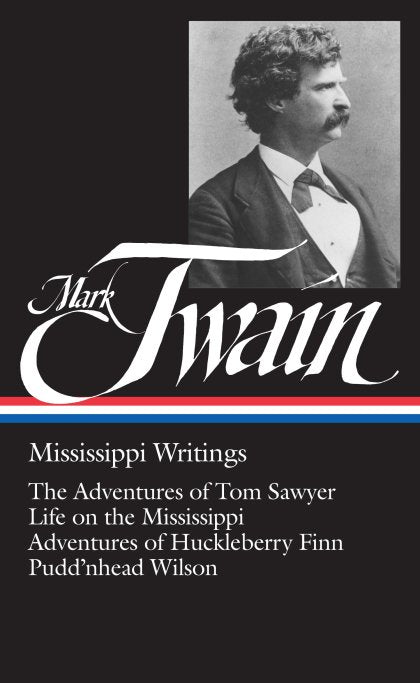
Mark Twain: Mississippi Writings (LOA #5)
Mark Twain: Mississippi Writings (LOA #5)
Couldn't load pickup availability
Collapsible content
ABOUT
Tom Sawyer “is simply a hymn,” said its author, “put into prose form to give it a worldly air,” a book where nostalgia is so strong that it dissolves the tensions and perplexities that assert themselves in the later works. Twain began Huckleberry Finn the same year Tom Sawyer was published, but he was unable to complete it for several more. It was during this period of uncertainty that Twain made a pilgrimage to the scenes of his childhood in Hannibal, Missouri, a trip that led eventually to Life on the Mississippi. The river in Twain’s descriptions is a bewitching mixture of beauty and power, seductive calms and treacherous shoals, pleasure and terror, an image of the societies it touches and transports.
Each of these works is filled with comic and melodramatic adventure, with horseplay and poetic evocations of scenery, and with characters who have become central to American mythology—not only Tom Sawyer and Huck Finn, but also Roxy, the mulatto slave in Puddn’head Wilson, one of the most telling portraits of a woman in American fiction. With each book there is evidence of a growing bafflement and despair, until with Puddn’head Wilson, high jinks and games, far from disguising the terrible cost of slavery, become instead its macabre evidence.
Through each of four works, too, runs the Mississippi, the river that T. S. Eliot, echoing Twain, was to call the “strong brown god.” For Twain, the river represented the complex and often contradictory possibilities in his own and his nation’s life. The Mississippi marks the place where civilization, moving west with its comforts and proprieties, discovers and contends with the rough realities, violence, chicaneries, and promise of freedom on the frontier. It is the place, too, where the currents Mark Twain learned to navigate as a pilot—an experience recounted in Life on the Mississippi—move inexorably into the Deep South, so that the innocence of joyful play and boyhood along its shores eventually confronts the grim reality of slavery.
LIBRARY OF AMERICA is an independent nonprofit cultural organization founded in 1979 to preserve our nation’s literary heritage by publishing, and keeping permanently in print, America’s best and most significant writing. The Library of America series includes more than 300 volumes to date, authoritative editions that average 1,000 pages in length, feature cloth covers, sewn bindings, and ribbon markers, and are printed on premium acid-free paper that will last for centuries.
STANDARD, PRIMARY, DM AND VARIANT COVERS
Standard and Primary covers are widely available through general retailers. They often have higher print runs and can be cheaper, especially during sales.
In contrast, Direct Market (DM) and variant covers are primarily sold in comic shops. DM editions tend to have more limited availability and may be more valuable to collectors.
The main differences lie in artwork style, availability, price, and collector appeal. Ultimately, the choice between standard and variant covers depends on personal preference, budget, and individual collecting goals.
PRODUCT TYPES
Comic book enthusiasts have various formats to choose from when collecting their favorite stories.
Here's a brief overview of the main types:
Omnibus
- Large, hardcover collections
- Usually contain complete runs or extensive story arcs
- Typically 800-1000+ pages
- Higher price point, often €100-€150
Oversized Hardcover (OHC)
- Similar dimensions to omnibus, but thinner
- Collect shorter runs or story arcs
- Usually 300-600 pages
- Priced between €30-€50
Hardcover (HC)
- Standard-sized hardcover books
- Collect 6-12 issues typically
- Similar dimensions to single issues, but with a hard cover
- Priced around €25-€35
Trade Paperback (TP)
- Softcover collections
- Standard comic book size
- Usually collect 4-6 issues
- Most affordable option, typically €15-€25
Other Formats
- Absolute Editions: Oversized, deluxe hardcovers (mainly DC Comics)
- Compendiums: Massive paperback collections
- Graphic Novels (OGN/GN): Original stories not previously released as single issues
The choice between these formats often depends on personal preference, budget, and collecting goals. Omnibus and OHC editions offer larger artwork and more content but at a higher price, while TPs provide a more affordable way to collect complete story arcs