

Knopf Doubleday Publishing Group
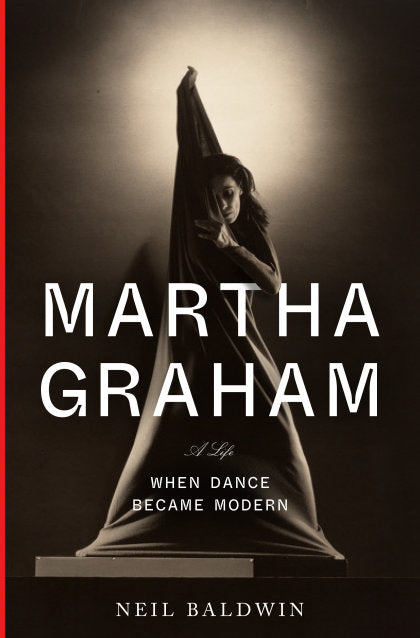
Martha Graham
Martha Graham
Couldn't load pickup availability
Collapsible content
ABOUT
"Brings together all the elements of Graham’s colorful life...with wit, verve, critical discernment, and a powerful lyricism.”—Mary Dearborn, acclaimed author of Ernest Hemingway
Time magazine called her “the Dancer of the Century.” Her technique, used by dance companies throughout the world, became the first long-lasting alternative to the idiom of classical ballet. Her pioneering movements—powerful, dynamic, jagged, edgy, forthright—combined with her distinctive system of training, were the epitome of American modernism, performance as art. Her work continued to astonish and inspire for more than sixty years as she choreographed more than 180 works.
At the heart of Graham’s work: movement that could express inner feeling.
Neil Baldwin, author of admired biographies of Man Ray (“Truly definitive . . . absolutely fascinating” —Patricia Bosworth) and Thomas Edison (“Absorbing, gripping, a major contribution to our understanding of a remarkable man and a remarkable era” —Robert Caro), gives us the artist and performer, the dance monument who led a cult of dance worshippers as well as the woman herself in all of her complexity.
Here is Graham, from her nineteenth-century (born in 1894) Allegheny, Pennsylvania, childhood, to becoming the star of the Denishawn exotic ballets, and in 1926, at age thirty-two, founding her own company (now the longest-running dance company in America).
Baldwin writes of how the company flourished during the artistic explosion of New York City’s midcentury cultural scene; of Erick Hawkins, in 1936, fresh from Balanchine’s School of American Ballet, a handsome Midwesterner fourteen years her junior, becoming Graham’s muse, lover, and eventual spouse. Graham, inspiring the next generation of dancers, choreographers, and teachers, among them: Merce Cunningham and Paul Taylor.
Baldwin tells the story of this large, fiercely lived life, a life beset by conflict, competition, and loneliness—filled with fire and inspiration, drive, passion, dedication, and sacrifice in work and in dance creation.
STANDARD, PRIMARY, DM AND VARIANT COVERS
Standard and Primary covers are widely available through general retailers. They often have higher print runs and can be cheaper, especially during sales.
In contrast, Direct Market (DM) and variant covers are primarily sold in comic shops. DM editions tend to have more limited availability and may be more valuable to collectors.
The main differences lie in artwork style, availability, price, and collector appeal. Ultimately, the choice between standard and variant covers depends on personal preference, budget, and individual collecting goals.
PRODUCT TYPES
Comic book enthusiasts have various formats to choose from when collecting their favorite stories.
Here's a brief overview of the main types:
Omnibus
- Large, hardcover collections
- Usually contain complete runs or extensive story arcs
- Typically 800-1000+ pages
- Higher price point, often €100-€150
Oversized Hardcover (OHC)
- Similar dimensions to omnibus, but thinner
- Collect shorter runs or story arcs
- Usually 300-600 pages
- Priced between €30-€50
Hardcover (HC)
- Standard-sized hardcover books
- Collect 6-12 issues typically
- Similar dimensions to single issues, but with a hard cover
- Priced around €25-€35
Trade Paperback (TP)
- Softcover collections
- Standard comic book size
- Usually collect 4-6 issues
- Most affordable option, typically €15-€25
Other Formats
- Absolute Editions: Oversized, deluxe hardcovers (mainly DC Comics)
- Compendiums: Massive paperback collections
- Graphic Novels (OGN/GN): Original stories not previously released as single issues
The choice between these formats often depends on personal preference, budget, and collecting goals. Omnibus and OHC editions offer larger artwork and more content but at a higher price, while TPs provide a more affordable way to collect complete story arcs