

Library of America
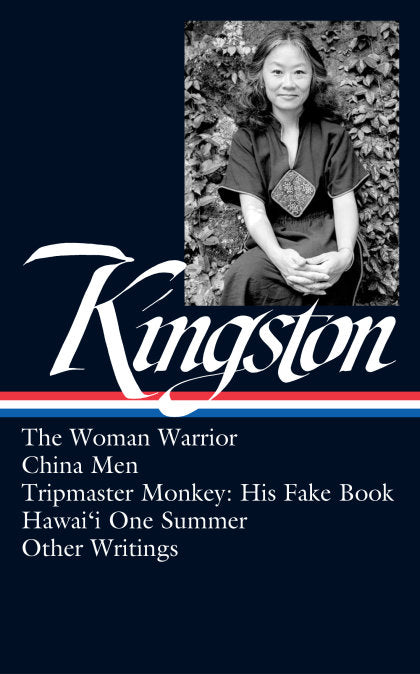
Maxine Hong Kingston: The Woman Warrior, China Men, Tripmaster Monkey, Hawai'i One Summer, Other Writings (LOA #355)
Maxine Hong Kingston: The Woman Warrior, China Men, Tripmaster Monkey, Hawai'i One Summer, Other Writings (LOA #355)
Couldn't load pickup availability
Collapsible content
ABOUT
Maxine Hong Kingston made a stunning entrance on the American literary scene with The Woman Warrior (1976), her “memoirs of a childhood among ghosts." Not only an account of growing up poor and Chinese American in the San Joaquin Valley, it was also an audacious feat of imaginative transformation and pathbreaking work of feminist autobiography, drawing on ancient myths and the family stories her mother brought over from China to make sense of a transformed life in America.
A companion to The Woman Warrior, which she called her “mother-book,” Kingston’s “father-book” China Men (1980) spreads out across a large geographical and historical canvas to envision the lives of her male relatives who immigrated to America. Taken together, The Woman Warrior and China Men offer a profound, kaleidoscopic, genre-defying narrative of the American experience.
Kingston's third book, Tripmaster Monkey: His Fake Book (1989), is the wildly inventive story of Wittman Ah Sing, a Berkeley graduate student whose experience of the San Francisco Beat scene transforms his understanding of his own Chinese heritage.
Rounding out the volume are a series of essays from 1978 reflecting on her life in Hawaii, later collected as Hawai‘i One Summer, personal musings whose subjects range from the contentions of a conference of Asian American writers to home-buying, surfing, and the work of the Beat poet Lew Welch.
Also included are hard-to-find essays about the creative process and Kingston’s exasperated, insightful account of how most of the reviewers of The Woman Warrior fell prey to lazy stereotypes about the “exotic” and “inscrutable” East.
STANDARD, PRIMARY, DM AND VARIANT COVERS
Standard and Primary covers are widely available through general retailers. They often have higher print runs and can be cheaper, especially during sales.
In contrast, Direct Market (DM) and variant covers are primarily sold in comic shops. DM editions tend to have more limited availability and may be more valuable to collectors.
The main differences lie in artwork style, availability, price, and collector appeal. Ultimately, the choice between standard and variant covers depends on personal preference, budget, and individual collecting goals.
PRODUCT TYPES
Comic book enthusiasts have various formats to choose from when collecting their favorite stories.
Here's a brief overview of the main types:
Omnibus
- Large, hardcover collections
- Usually contain complete runs or extensive story arcs
- Typically 800-1000+ pages
- Higher price point, often €100-€150
Oversized Hardcover (OHC)
- Similar dimensions to omnibus, but thinner
- Collect shorter runs or story arcs
- Usually 300-600 pages
- Priced between €30-€50
Hardcover (HC)
- Standard-sized hardcover books
- Collect 6-12 issues typically
- Similar dimensions to single issues, but with a hard cover
- Priced around €25-€35
Trade Paperback (TP)
- Softcover collections
- Standard comic book size
- Usually collect 4-6 issues
- Most affordable option, typically €15-€25
Other Formats
- Absolute Editions: Oversized, deluxe hardcovers (mainly DC Comics)
- Compendiums: Massive paperback collections
- Graphic Novels (OGN/GN): Original stories not previously released as single issues
The choice between these formats often depends on personal preference, budget, and collecting goals. Omnibus and OHC editions offer larger artwork and more content but at a higher price, while TPs provide a more affordable way to collect complete story arcs