

Random House Publishing Group
Midnight in Europe
Midnight in Europe
Couldn't load pickup availability
Collapsible content
ABOUT
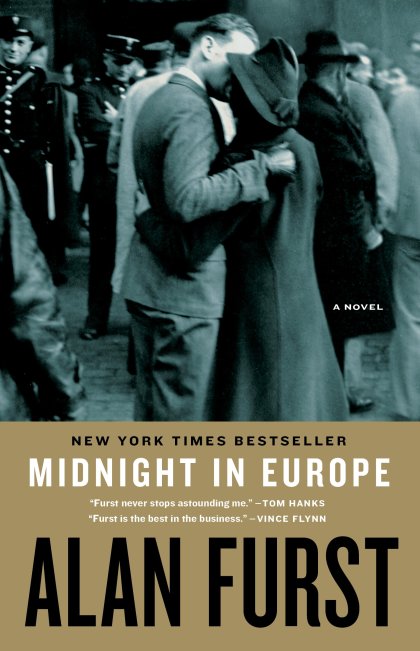
Paris, 1938. As the shadow of war darkens Europe, democratic forces on the Continent struggle against fascism and communism, while in Spain the war has already begun. Alan Furst, whom Vince Flynn has called “the most talented espionage novelist of our generation,” now gives us a taut, suspenseful, romantic, and richly rendered novel of spies and secret operatives in Paris and New York, in Warsaw and Odessa, on the eve of World War II.
Cristián Ferrar, a brilliant and handsome Spanish émigré, is a lawyer in the Paris office of a prestigious international law firm. Ferrar is approached by the embassy of the Spanish Republic and asked to help a clandestine agency trying desperately to supply weapons to the Republic’s beleaguered army—an effort that puts his life at risk in the battle against fascism.
Joining Ferrar in this mission is a group of unlikely men and women: idealists and gangsters, arms traders and aristocrats and spies. From shady Paris nightclubs to white-shoe New York law firms, from brothels in Istanbul to the dockyards of Poland, Ferrar and his allies battle the secret agents of Hitler and Franco. And what allies they are: there’s Max de Lyon, a former arms merchant now hunted by the Gestapo; the Marquesa Maria Cristina, a beautiful aristocrat with a taste for danger; and the Macedonian Stavros, who grew up “fighting Bulgarian bandits. After that, being a gangster was easy.” Then there is Eileen Moore, the American woman Ferrar could never forget.
In Midnight in Europe, Alan Furst paints a spellbinding portrait of a continent marching into a nightmare—and the heroes and heroines who fought back against the darkness.
Praise for Alan Furst and Midnight in Europe
“Furst never stops astounding me.”—Tom Hanks
“Furst is the best in the business.”—Vince Flynn
“Elegant, gripping . . . [Furst] remains at the top of his game.”—The New York Times
“Suspenseful and sophisticated . . . No espionage author, it seems, is better at summoning the shifting moods and emotional atmosphere of Europe before the start of World War II than Alan Furst.”—The Wall Street Journal
“Endlessly compelling . . . Furst delivers an observant, sexy, and thrilling tale set in the outskirts of World War II. In Furst’s hands, Paris once again comes alive with intrigue.”—Erik Larson
“Too much fun to put down . . . [Furst is] a master of the atmospheric thriller.”—The Boston Globe
STANDARD, PRIMARY, DM AND VARIANT COVERS
Standard and Primary covers are widely available through general retailers. They often have higher print runs and can be cheaper, especially during sales.
In contrast, Direct Market (DM) and variant covers are primarily sold in comic shops. DM editions tend to have more limited availability and may be more valuable to collectors.
The main differences lie in artwork style, availability, price, and collector appeal. Ultimately, the choice between standard and variant covers depends on personal preference, budget, and individual collecting goals.
PRODUCT TYPES
Comic book enthusiasts have various formats to choose from when collecting their favorite stories.
Here's a brief overview of the main types:
Omnibus
- Large, hardcover collections
- Usually contain complete runs or extensive story arcs
- Typically 800-1000+ pages
- Higher price point, often €100-€150
Oversized Hardcover (OHC)
- Similar dimensions to omnibus, but thinner
- Collect shorter runs or story arcs
- Usually 300-600 pages
- Priced between €30-€50
Hardcover (HC)
- Standard-sized hardcover books
- Collect 6-12 issues typically
- Similar dimensions to single issues, but with a hard cover
- Priced around €25-€35
Trade Paperback (TP)
- Softcover collections
- Standard comic book size
- Usually collect 4-6 issues
- Most affordable option, typically €15-€25
Other Formats
- Absolute Editions: Oversized, deluxe hardcovers (mainly DC Comics)
- Compendiums: Massive paperback collections
- Graphic Novels (OGN/GN): Original stories not previously released as single issues
The choice between these formats often depends on personal preference, budget, and collecting goals. Omnibus and OHC editions offer larger artwork and more content but at a higher price, while TPs provide a more affordable way to collect complete story arcs