

Random House Publishing Group
Miracle on the Hudson
Miracle on the Hudson
Couldn't load pickup availability
Collapsible content
ABOUT
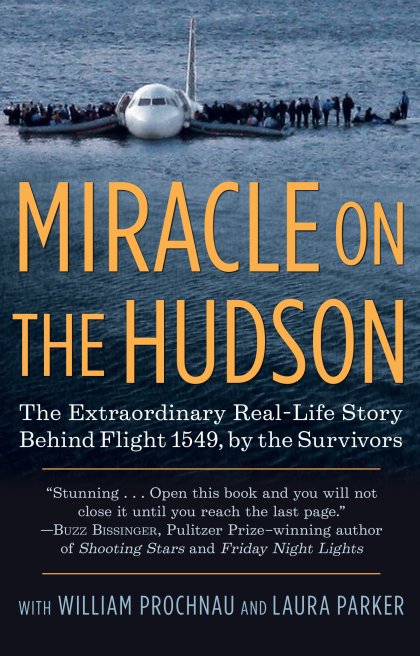
Millions watched the aftermath on television, while others witnessed the event actually happening from the windows of nearby skyscrapers. But only 155 people know firsthand what really happened on U.S. Airways Flight 1549 on January 15, 2009. Now, for the first time, the survivors detail their astounding, terrifying, and inspiring experiences on that freezing winter day in New York City. Written by two esteemed journalists, Miracle on the Hudson is the entire tale from takeoff to bird strike to touchdown to rescue, seen through the eyes and felt in the souls of those on board the fateful flight.
Revealing many new and compelling details, Miracle on the Hudson dramatically evokes the explosion and "smell of burning flesh" as both engines were destroyed by geese, the violent landing on the river that felt like a "huge car wreck," the gridlock in the aisles as the plane filled swiftly with freezing water, and the thrill of the passengers' rescue from the wings and from rafts—all of it recalled by the "cross section of America" on board.
Jay McDonald, a thirty-nine-year-old software developer, had survived brain-tumor surgery just two years earlier and now faced the unimaginable.
Tracey Wolsko, a nervous flier, suddenly became other people's rock: "Just pray. It's going to be all right." Jim Whitaker, a construction executive, reassured a nervous mother of two young children on board, only later admitting, "I was pathologically lying the whole time." As the plane started sinking, Lucille Palmer, eighty-five, told her daughter to save herself: "Just leave me!"
Featuring much more than what the media reported—moments of chaos in addition to stoicism and common sense, and the fortuitous mistakes and quick instincts that saved lives that otherwise would have been lost—Miracle on the Hudson is the chronicle of one of the most phenomenal feel-good stories of recent years, one that could have been a nightmare and instead became a stirring narrative of heroism and hope for our times.
STANDARD, PRIMARY, DM AND VARIANT COVERS
Standard and Primary covers are widely available through general retailers. They often have higher print runs and can be cheaper, especially during sales.
In contrast, Direct Market (DM) and variant covers are primarily sold in comic shops. DM editions tend to have more limited availability and may be more valuable to collectors.
The main differences lie in artwork style, availability, price, and collector appeal. Ultimately, the choice between standard and variant covers depends on personal preference, budget, and individual collecting goals.
PRODUCT TYPES
Comic book enthusiasts have various formats to choose from when collecting their favorite stories.
Here's a brief overview of the main types:
Omnibus
- Large, hardcover collections
- Usually contain complete runs or extensive story arcs
- Typically 800-1000+ pages
- Higher price point, often €100-€150
Oversized Hardcover (OHC)
- Similar dimensions to omnibus, but thinner
- Collect shorter runs or story arcs
- Usually 300-600 pages
- Priced between €30-€50
Hardcover (HC)
- Standard-sized hardcover books
- Collect 6-12 issues typically
- Similar dimensions to single issues, but with a hard cover
- Priced around €25-€35
Trade Paperback (TP)
- Softcover collections
- Standard comic book size
- Usually collect 4-6 issues
- Most affordable option, typically €15-€25
Other Formats
- Absolute Editions: Oversized, deluxe hardcovers (mainly DC Comics)
- Compendiums: Massive paperback collections
- Graphic Novels (OGN/GN): Original stories not previously released as single issues
The choice between these formats often depends on personal preference, budget, and collecting goals. Omnibus and OHC editions offer larger artwork and more content but at a higher price, while TPs provide a more affordable way to collect complete story arcs