

Knopf Doubleday Publishing Group
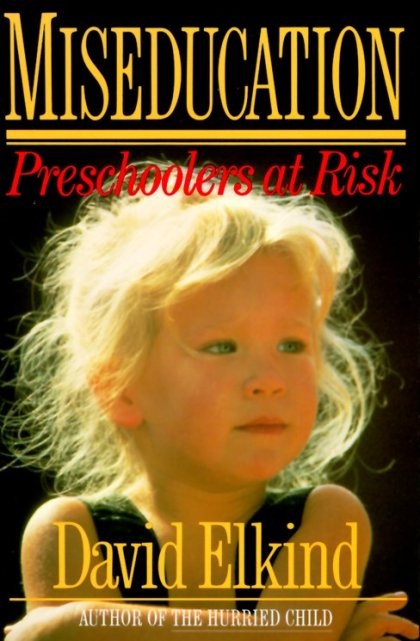
Miseducation
Miseducation
Couldn't load pickup availability
Collapsible content
ABOUT
Across the country—in schools and in homes—educational programs intended for school-age children are being misappropriated for the instruction of preschoolers. Books, lectures, and the media propagate the idea that only a “superkid” can grow up to compete successfully in the adult world—thereby encouraging parents to teach infants and young children academic and athletic skills. Yet, there is considerable evidence that early instruction can do lasting harm—that young children subjected to this kind of pressure are, in fact, at psychological and physical risk.
Dr. Elkind shows us the very real difference between the mind of a preschool child (how it works) and that of a school-age child. He makes clear how much young children can and do learn when they are presented with developmentally appropriate parenting practices and education. He shows us how healthy education supports and encourages the spontaneous learning process through which young children explore and understand their immediate world, and how miseducation ignores it, attempting to teach the wrong things at the wrong time. And, in turn, we see how early miseducation can cause permanent damage to a child’s self-esteem, the loss of the positive attitude a child needs for learning the blocking of natural gifts and potential talents.
Finally, Dr. Elkind discusses what parents should look for when deciding upon the initial stages of their children’s education and what preschool programs are the most considerate of the individual child. In a special section, he answers the most common questions he’s heard from parents.
STANDARD, PRIMARY, DM AND VARIANT COVERS
Standard and Primary covers are widely available through general retailers. They often have higher print runs and can be cheaper, especially during sales.
In contrast, Direct Market (DM) and variant covers are primarily sold in comic shops. DM editions tend to have more limited availability and may be more valuable to collectors.
The main differences lie in artwork style, availability, price, and collector appeal. Ultimately, the choice between standard and variant covers depends on personal preference, budget, and individual collecting goals.
PRODUCT TYPES
Comic book enthusiasts have various formats to choose from when collecting their favorite stories.
Here's a brief overview of the main types:
Omnibus
- Large, hardcover collections
- Usually contain complete runs or extensive story arcs
- Typically 800-1000+ pages
- Higher price point, often €100-€150
Oversized Hardcover (OHC)
- Similar dimensions to omnibus, but thinner
- Collect shorter runs or story arcs
- Usually 300-600 pages
- Priced between €30-€50
Hardcover (HC)
- Standard-sized hardcover books
- Collect 6-12 issues typically
- Similar dimensions to single issues, but with a hard cover
- Priced around €25-€35
Trade Paperback (TP)
- Softcover collections
- Standard comic book size
- Usually collect 4-6 issues
- Most affordable option, typically €15-€25
Other Formats
- Absolute Editions: Oversized, deluxe hardcovers (mainly DC Comics)
- Compendiums: Massive paperback collections
- Graphic Novels (OGN/GN): Original stories not previously released as single issues
The choice between these formats often depends on personal preference, budget, and collecting goals. Omnibus and OHC editions offer larger artwork and more content but at a higher price, while TPs provide a more affordable way to collect complete story arcs